Topps Basketball: Hobby Box Prices, Key Seasons and the 2025-26 Return
Topps Basketball is the NBA's flagship base set again after a fifteen-year absence, and it is one of the few basketball lines whose sealed market spans two completely separate eras. The original run went from 1992-93, when Topps returned to the NBA after a decade away, through 2009-10, when Panini took the exclusive license. Fanatics-owned Topps got the license back effective October 1, 2025, and the 2025-26 edition landed on October 23, 2025. This page covers the box formats, the seasons that actually trade, and what a sealed Topps Basketball box is worth in each era.
Buy Topps Basketball sealed
All listings on eBay → 1992-93 Wax Pack
$14.95
1992-93 Wax Pack
$14.95
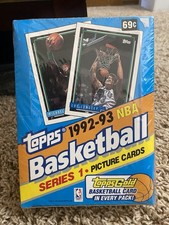 1992-93 Wax Box
$400.00
1992-93 Wax Box
$400.00
 2003-04 Hobby Box
$1,249.98
2003-04 Hobby Box
$1,249.98
 1996-97 Retail Box
$2,800.00
1996-97 Retail Box
$2,800.00
 2009-10 Blaster Box
$12,999.99
2009-10 Blaster Box
$12,999.99
Prices update daily from live eBay listings. Prefer to buy in person? Find a local card shop · All NBA sealed
Quick facts
| Brand | Topps |
| First season | 1992-93 (modern run); returned 2025-26 |
| Release window | October, at the start of the NBA season |
| License | NBA and NBPA licensed 1992-93 through 2009-10, and again from 2025-26 |
| Box formats | Hobby, Hobby Jumbo, Mega, Blaster, Value, Hanger, Retail Display |
| Guaranteed hits | Hobby: one autograph or relic per box; Jumbo: one autograph and one relic |
| 2025-26 hobby box (Aug 2026) | $230-$370 secondary; roughly $420 at distributor |
Box formats for Topps Basketball
Hobby Box
The 2025-26 hobby box is 20 packs of 12 cards with an average of one autograph or relic, one numbered parallel and a bonus promo pack. Distributors list it near $420, but because Topps printed the return heavily and shipped it into a crowded fall calendar, sealed boxes trade below that on the secondary market, generally $230 to $370. It is the cheapest way into a licensed 300-card base set with the full Cooper Flagg rookie class.
Hobby Jumbo Box
Jumbo is 10 packs of 40 cards and guarantees both an autograph and a relic, plus two exclusive Silver Packs and a deeper run of numbered parallels. It sells for roughly $520 to $600 and is the format set builders prefer, since 400 cards gets most of the way through a 300-card checklist in one box.
Mega, Blaster, Value and Hanger
Retail runs 16 packs of 14 cards in the mega, 12 packs of 12 in the blaster and value configurations, and single-pack hangers. None guarantee a hit, but each SKU carries its own border colors and retail-only inserts, including Sonic Boom, which never appears in hobby.
Hobby Case
A hobby case is 12 boxes and is the unit where case-hit SSPs like Home Court and Comic Court are seeded. Cases move at a small discount to twelve times box price while the season is in print.
Vintage wax (1992-93 to 2009-10)
Older Topps basketball came in 36-pack hobby boxes for most of the run, and in the 1990s in Series 1 and Series 2 configurations. Series 2 boxes from 1996-97 matter far more than Series 1 because the Kobe Bryant rookie sits in the second series.
Key seasons: prices and key rookies
| Season | Hobby box (Aug 2026) | Other formats | Key rookies / chase |
|---|---|---|---|
| 2025-26 | $230-$370 | Jumbo $520-$600 | Cooper Flagg, Dylan Harper, VJ Edgecombe, Ace Bailey, Kon Knueppel |
| 2009-10 | $8,000-$25,000 (thin) | Retail scarce | Stephen Curry, James Harden, Blake Griffin; Chrome inserts /999 |
| 2007-08 | $850-$1,200 | Retail $150-$300 | Kevin Durant, Al Horford, Joakim Noah |
| 2003-04 | $2,000-$3,500 | Retail $400-$800 | LeBron James, Dwyane Wade, Carmelo Anthony, Chris Bosh |
| 1996-97 (Series 2) | $3,000-$4,000 | Retail box $2,500-$2,900 | Kobe Bryant, Allen Iverson, Steve Nash, Ray Allen |
| 1992-93 | $125-$300 | Retail similar | Shaquille O'Neal, Alonzo Mourning; Topps returns to the NBA |
Two seasons carry the vintage market. 1996-97 Series 2 is the Kobe box, and it trades on the strength of a single card in a set printed in ordinary mid-1990s quantities, which is why raw wax still surfaces at shows. 2009-10 is the outlier: Topps' last licensed season, a Curry rookie class, and a set where the Chrome parallels inside the packs outvalue the base cards. That box is thinly traded and quoted anywhere from four to five figures, so treat any single asking price as a starting point rather than a market. 2003-04 sits in between, with three Hall of Fame rookies in a 36-pack box and a supply that has been steadily opened for twenty years.
The 2025-26 edition is a different proposition. It is a first-year licensed set with a heavily hyped rookie class, but it was printed at modern scale and sold at retail, so it is currently the least expensive licensed NBA hobby box on the shelf. Whether it appreciates depends almost entirely on Flagg.
Chase cards, parallels and hit rates
The 2025-26 base set runs 300 cards including 45 rookies and 30 combo cards, under a wide rainbow of colored and patterned borders down to numbered short prints. Golden Mirror parallels are the marquee short print and First Card 1/1s sit at the top. Case-hit SSPs include Home Court and Comic Court, and the retro insert program runs a couple of dozen sets built on old Topps designs, including 1980-81 Topps Basketball throwbacks, New School using the 1997-98 look, and No Limit from 2000-01.
Autograph content is deliberately light for a flagship: one autograph or relic per hobby box, with jumbo guaranteeing one of each. That keeps the price down and makes this a set-building release rather than a hit-chasing one. Autographs barely existed in flagship Topps before the mid-2000s, so vintage boxes are valued on rookie base cards and, in 2009-10, on the Chrome inserts numbered to 999.
Is Topps Basketball worth buying sealed?
For the current season, honestly, no more than as a fun rip. A $250 to $350 box with one autograph or relic will not beat its cost on average, and the print run is large. Where flagship Topps has always paid off is on a decade timeline in seasons with a generational rookie, bought cheap and left alone. That is the argument for 2025-26 if you believe in Cooper Flagg, and it is why 1996-97 Series 2 and 2003-04 boxes cost what they do now after being $30 to $60 at release.
The vintage side carries the opposite risk profile: prices are high, liquidity is poor, and provenance drives as much of the number as the cards inside. A 2009-10 box with an uncertain history is a much worse buy than a 2007-08 box from a known source at a fair price.
How to spot fakes and resealed boxes
For 1990s and 2000s Topps wax, the tells are the same as any vintage box: check that the cellophane seams are factory-tight and centered, that the flaps have no lift marks or glue residue, and that pack wrappers inside are uniform. Boxes advertised as having tape on them have been opened at the case level at minimum. Because 1996-97 Series 2 and 2003-04 boxes are worth thousands, buy them authenticated by a third party such as BBCE or through an auction house that inspects wax, and expect authenticated boxes to trade at a premium over raw sealed. Searching is a real risk on 36-pack vintage boxes.
Modern boxes ship shrink-wrapped with a factory seal; look for a clean bottom seam and consistent pack alignment. Retail blasters and megas are the most-searched format, so buy them from a shop rather than off a picked-over peg. Weighing does not work here because parallels use the same stock as base cards.
Where to buy Topps Basketball sealed
Local shops carry current-season hobby, jumbo and retail, and often price boxes under eBay once the launch rush passes. Card shows are the better venue for vintage wax, where you can inspect a 1996-97 or 2003-04 box in hand instead of trusting photos. To cut the noise on eBay, search:
Frequently asked questions
Is Topps Basketball licensed by the NBA again?
Yes. Topps, owned by Fanatics, took the NBA and NBPA license effective October 1, 2025, and 2025-26 Topps Basketball is fully licensed with team logos and uniforms. Topps had previously been licensed from 1992-93 through 2009-10.
How much is a 2025-26 Topps Basketball hobby box?
On the August 2026 secondary market, sealed 2025-26 hobby boxes sold in the $230 to $370 range, while distributors listed them near $420. Hobby jumbo boxes ran roughly $520 to $600.
What is in a 2025-26 Topps Basketball hobby box?
Twenty packs of 12 cards, with an average of one autograph or relic card, one numbered parallel and a bonus promo pack. The base set is 300 cards including 45 rookies.
Which Topps Basketball seasons are worth the most sealed?
1996-97 Series 2 for the Kobe Bryant rookie, 2003-04 for LeBron James, Dwyane Wade and Carmelo Anthony, and 2009-10 for Stephen Curry. The 2009-10 box is the scarcest and most thinly traded of the three.
Why did Topps stop making NBA cards after 2009-10?
Panini won the exclusive NBA and NBPA license beginning with the 2009-10 season cycle, which shut Topps, Upper Deck and every other manufacturer out of licensed NBA cards until the 2025-26 season.
Is Topps Basketball the same as Topps Chrome?
No. Topps Basketball is the paper flagship set. Topps Chrome is a separate chromium-stock release with Refractor parallels, its own checklist and a much higher box price.
Related sets
Prices in this guide were last reviewed 2026-08. Live eBay listings above update daily.