Fleer Football: Sealed Box Prices, Key Years and the End of the Brand
Fleer had made football cards on and off since 1960, but the line collectors mean when they say Fleer football is the modern run that began in 1990. It was the value flagship of the junk wax era, it was renamed Fleer Tradition for most of the late 1990s and early 2000s, and it ended twice: once when Fleer went out of business in 2005, and again after Upper Deck bought the brand assets and issued a final Fleer-branded NFL set in 2006. Sealed boxes are cheap, widely available and heavily searched, which is the whole story of buying them.
Buy Fleer Football sealed
All listings on eBay → 1990 Wax Pack
$3.38
1990 Wax Pack
$3.38
 1991 Wax Pack
$3.49
1991 Wax Pack
$3.49
 1992 Wax Pack
$3.53
1992 Wax Pack
$3.53
 1992 Wax Box
$58.00
1992 Wax Box
$58.00
 1997 Retail Box
$118.97
1997 Retail Box
$118.97
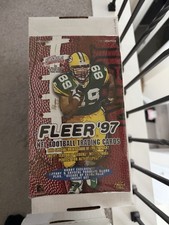 1997 Hobby Box
$239.99
1997 Hobby Box
$239.99
Prices update daily from live eBay listings. Prefer to buy in person? Find a local card shop · All NFL sealed

Quick facts
| Brand | Fleer |
| First modern year | 1990 |
| Release window | Late summer for the flagship, with update and traded issues in-season |
| License | NFL licensed; Fleer folded in 2005 and Upper Deck issued the last Fleer NFL football in 2006 |
| Box formats | Hobby wax box, retail box, jumbo and cello, blaster, factory set, case |
| Guaranteed hits | None in the early 1990s; insert and autograph seeding arrives later in the run |
| Typical sealed box range (Aug 2026) | Roughly $20 to $80 for junk wax years; more for the scarcer later issues |
Box formats for Fleer Football
Hobby wax box (1990s)
The early boxes are large-count wax configurations, typically 36 packs, sold at pocket-money pack prices. These are set-building boxes: no guaranteed hits, big base checklists and inserts seeded at moderate odds. They were produced in enormous quantities and are the reason the phrase junk wax exists.
Retail box, jumbo and cello
Retail wax, jumbo packs and cello configurations exist across the run and generally trade below hobby. Cello packs from the early 1990s have a small following because visible top and bottom cards allow a form of legitimate searching, which cuts both ways when you are buying sealed.
Fleer Tradition boxes
From 1998 the flagship was renamed Fleer Tradition, running under that name in 1998, 1999, 2000 and 2001, then again in 2003 and 2004, with a plain Fleer branded set in 2002. If you are looking for a 1999 or 2000 Fleer flagship box, you are looking for Fleer Tradition; that line has its own page.
2006 Fleer boxes
After Fleer's 2005 collapse, Upper Deck acquired the brand and issued a Fleer-branded NFL football set in 2006. These boxes are the end of the line and were produced in far smaller quantities than the 1990s issues, which makes them the scarcest wax carrying the plain Fleer football name.
Factory sets and cases
Fleer issued factory sets in most years. A sealed factory set is a cheap way to own a complete run and should never be confused with a wax box in a listing. Sealed cases exist and are the best provenance available for the junk wax years.
Key years: prices and what trades
| Year | Sealed box range (Aug 2026) | Format | Why it trades |
|---|---|---|---|
| 1990 | $20-$60 | 36-pack wax | Return of the Fleer NFL flagship; Emmitt Smith rookie year content |
| 1991 | $20-$55 | 36-pack wax | Brett Favre rookie year across the industry; large print run |
| 1994 | $25-$70 | Wax box | Marshall Faulk, Trent Dilfer; better design era |
| 1996 | $30-$85 | Wax box | Eddie George, Terrell Owens, Marvin Harrison rookie class |
| 2002 | $40-$120 | Hobby box | Plain Fleer branding between Tradition years; Julius Peppers, Ed Reed |
| 2006 | $60-$180 | Hobby box | Final Fleer-branded NFL set, issued by Upper Deck; small print |
The junk wax years are cheap for a good reason: Fleer printed them in quantities that will never be exhausted, and the base cards are worth cents. What people buy is the experience and the nostalgia, and at $25 to $60 a box that is a fair trade. The genuinely interesting years are at the ends of the run. 1990 matters because it is the return of the flagship; 2006 matters because it is the last one, and because Upper Deck's Fleer-branded football was produced in small numbers relative to anything from the 1990s.
Sold-price data for this wax is poor. The mainstream price guides track single cards, not Fleer football boxes, and low-value wax often changes hands at shows and in shop cases without appearing online at all. Every range above is a corridor built from dealer asks and scattered results rather than a sold index, and shipping cost is a meaningful share of the price at the bottom end, which distorts online comparisons.
Chase cards, parallels and hit rates
The early 1990s sets are insert-driven rather than hit-driven. All-Pro, Pro-Vision and league leader inserts fall at moderate odds, and the parallels are limited. Nothing in a 1990 through 1993 box is scarce in any meaningful sense.
From the mid-1990s Fleer added serial-numbered parallels and, later, autographed and game-used content, though the flagship always stayed leaner than SkyBox, Ultra or Flair Showcase in this respect. If you want Fleer-family hits, the premium brands are where they live. The 2002 and 2006 issues carry the most modern structure with numbered parallels and limited signed content.
Nobody should buy a 1990s Fleer football box expecting a guaranteed hit. There is not one, and listings that suggest otherwise are describing a different product.
Is Fleer football worth buying sealed?
For the junk wax years, buy it to open, not to hold. Print runs were vast, the cards are commons, and the only realistic upside is a high-grade star card, which is a poor bet given the centering and print quality of the era. The pleasure of the product is genuine and the cost is low; treat it that way.
The exceptions sit at the edges of the run. The 2006 Upper Deck-issued Fleer boxes are legitimately scarce and represent the terminal point of a brand that no longer exists in any form, which gives them a story that no 1993 box has. Sealed cases of any year are worth more per box than loose boxes because they answer the search question.
The brand is finished. Fleer folded in 2005, Upper Deck issued the last Fleer-branded NFL football in 2006, and Upper Deck's own NFL license ended after the 2009 season. Nothing new will be added.
How to spot fakes and resealed boxes
Cheap wax gets searched more casually than expensive wax, because the cost of buying a box to search is trivial. That is the central risk with Fleer football: not a counterfeit box, but a box that was opened, picked over for stars and inserts and reshrunk with modern film.
Learn the wrap. Original Fleer shrink from this era is thin and follows the box corners tightly, and factory seams tuck under an edge rather than crossing a face. Replacement film is thicker and glossier, often with a visible heat seam across a flat side and sometimes a puckered patch where a heat gun lingered. Inside, check that pack count matches the configuration, that packs sit at uniform height with no shimming and that no cellophane pack shows a slit and retape at the seam.
For the 1990 through 1996 boxes, BBCE-style third-party authentication exists and matters more than the low prices suggest, because it is precisely the cheap wax that gets searched. An authenticated, graded-unsearched box trades in a distinctly higher band than a raw sealed one, and on a $40 box the authentication premium can approach the value of the box itself, which is a real argument for buying case-fresh instead. Weighing packs is useless; the inserts are the same card stock as the base cards.
Where to buy Fleer football sealed
This is the definition of shop and show inventory. Local stores have held Fleer wax since it was new and often price it below the online market once shipping is counted. Card shows are where the junk wax era genuinely trades, frequently in multi-box lots at a negotiated price. Online, be specific so you do not end up buying a factory set:
Frequently asked questions
Is Fleer football still made?
No. Fleer went out of business in 2005, Upper Deck acquired the brand and issued the last Fleer-branded NFL football set in 2006, and Upper Deck's own NFL license ended after the 2009 season. The brand is finished for NFL cards.
What happened to Fleer football between 1998 and 2001?
The flagship was renamed Fleer Tradition and ran under that name in 1998, 1999, 2000 and 2001, then again in 2003 and 2004. A plain Fleer branded set appeared in 2002.
How much is a 1990 Fleer football box worth?
Roughly $20 to $60 depending on condition and whether it is authenticated. Public sales are irregular and shipping is a large share of the cost, so treat that band as a corridor.
Are 1990s Fleer football boxes a good investment?
Generally no. Print runs were enormous and the base cards are commons. Buy them to open and enjoy rather than to hold, and put any investment budget into scarcer issues.
Which Fleer football box is the hardest to find?
The 2006 issue, produced by Upper Deck after Fleer's collapse, was made in far smaller quantities than any 1990s year and is the scarcest wax carrying the plain Fleer football name.
Do Fleer football boxes get resealed?
Yes, frequently, because the low box price makes searching cheap. Check wrap thickness, seam placement, pack alignment and cellophane seams, and prefer case-fresh or third-party authenticated boxes.
Related sets
Prices in this guide were last reviewed 2026-08. Live eBay listings above update daily.