Score Football: 1989 Wax Boxes, Panini Hobby Boxes and Prices
Score arrived in 1989 as one of the sets that broke Topps' grip on football, and finished as Panini's cheapest hobby box, the one that put four autographs in a $185 product. The two eras trade completely differently, and this page covers both, from BBCE-wrapped 1989 wax to the 2025 edition, the last Score football made before Panini's NFL and NFLPA licenses expired on March 31, 2026.
Buy Score Football sealed
All listings on eBay → 1991 Wax Pack
$3.00
1991 Wax Pack
$3.00
 1990 Wax Pack
$3.95
1990 Wax Pack
$3.95
 2025 Panini Value Pack
$5.99
2025 Panini Value Pack
$5.99
 2025 Panini Blaster Box
$21.99
2025 Panini Blaster Box
$21.99
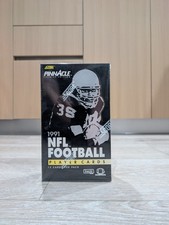 1991 Wax Box
$25.00
1991 Wax Box
$25.00
 2025 Panini Mega Box
$34.99
2025 Panini Mega Box
$34.99
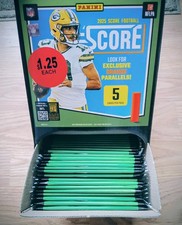 2025 Panini Hanger Box
$79.99
2025 Panini Hanger Box
$79.99
 2025 Panini Hobby Box
$281.15
2025 Panini Hobby Box
$281.15
 1989 Wax Box
$1,499.99
1989 Wax Box
$1,499.99
Prices update daily from live eBay listings. Prefer to buy in person? Find a local card shop · All NFL sealed

Quick facts
| Brand | Score, under Panini from 2009 |
| First year | 1989 |
| Release window | Panini era: early summer; the 2025 edition released July 3, 2025 |
| License | NFL and NFLPA licensed through the 2025 season under Panini; both ended March 31, 2026 |
| Box formats | Hobby, blaster, mega, retail box, cello, plus 1989-1998 wax boxes |
| Guaranteed hits | Modern hobby: 4 autographs. 1989-era wax: none |
| 2025 hobby box (Aug 2026) | $215-$355 |
Box formats for Score football
Hobby Box (Panini era)
The modern hobby box is ten packs with four autographs, roughly fifty rookies and around twenty-four inserts. The configuration changed for 2025: earlier years ran forty cards a pack, while 2025 dropped to twenty, halving the card count. MSRP was $184.95, and boxes were fetching $215-$355 in August 2026. Four signatures at that price is the best autograph-per-dollar ratio Panini offered in football.
Blaster and Mega Boxes
Retail blasters carry parallels hobby cannot produce, including the Cubic /185 and Dots Red /25 versions in 2025, and no autograph guarantee. Because Score retail is cheap and widely distributed, it is the format most likely to have been searched before resale.
Retail Box and Cello
Retail 24-pack boxes and cello packs are the cheapest per-card route into the 400-card base set. Neither has a hit guarantee, and both suit set builders rather than breakers.
Wax Box (1989-1998)
The original configuration is a 36-pack wax box with fifteen cards a pack and no inserts or hits in the modern sense. These now trade as vintage-adjacent wax and are usually sold with third-party authentication rather than in raw shrink.
Hobby Case
Twelve hobby boxes in the Panini era, which is where the scarcest numbered parallels and the 1/1 Gem Masters are seeded.
Key years: prices and key rookies
| Year | Sealed box (Aug 2026) | Format | Key rookies and chases |
|---|---|---|---|
| 1989 | $1,600-$5,700 | 36-pack wax box | Barry Sanders, Troy Aikman, Deion Sanders, Michael Irvin, Cris Carter, Tim Brown |
| 2025 | $215-$355 | hobby, 10 packs x 20 | Cam Ward, Travis Hunter, Ashton Jeanty, Shedeur Sanders |
| 2024 | $170-$325 | hobby, 10 packs x 40 | Caleb Williams, Jayden Daniels, Malik Nabers, Brock Bowers |
| 2023 | $177-$240 | hobby, 10 packs x 40 | C.J. Stroud, Bijan Robinson, Anthony Richardson, Puka Nacua |
| 2022 | $175-$240 | hobby, 10 packs x 40 | Kenny Pickett, Garrett Wilson, Chris Olave, Drake London |
| 2021 | $175-$300 | hobby, 10 packs x 40 | Trevor Lawrence, Justin Fields, Najee Harris, Ja'Marr Chase |
1989 is the exception in the junk wax era and the reason this brand still matters. Score printed far less of it than Pro Set did that year, the checklist carries Barry Sanders, Aikman, Deion Sanders, Irvin, Carter and Tim Brown, and sealed boxes have appreciated well beyond anything else from 1989. The spread is enormous because authentication matters more than condition: a BBCE-wrapped box sits at the top of the range and a raw sealed box far below.
The Panini years are a different market. Score was the entry-level release, printed in very large quantities, and its boxes have never appreciated meaningfully, though they never collapse either because four autographs give a box a floor. 2025 is the last one made and trades above 2024, albeit with half the cards.
Chase cards, parallels and hit rates
In the Panini era the base set runs 300 veterans and 100 rookies, with more than twenty-five parallels above it: Gold, Green, Red, Purple and Orange at various print runs, plus Gem Masters 1/1 and printing plates. Hobby-exclusive inserts have included Breakthrough, Toe the Line, Hot Rookies, NFL Draft and Squad, alongside short-printed Showtime cards and the Men of Canton set. Lenticular inserts appear in some years.
Autographs are the point of the modern product. Four per box is a hard guarantee drawn mostly from the rookie class, so a box's outcome depends on which four names you get rather than on parallel luck. The 1989-1998 wax boxes have no signed content; the value there is entirely in high-grade rookie cards, and the grading math on 1989 stock is brutal because of centering.
Is Score football worth buying sealed?
The two eras need separate answers. Modern Score is the most honest cheap box in football: four autographs for under $250 means you know roughly what you are getting, and it suits a group break or a first hobby box. It is not an investment, because Panini printed a great deal of it.
The 1989 wax box is the opposite. It is a scarce, closed-supply item where the sensible purchase is an authenticated box rather than a cheap raw one. Even at $2,000 the expected grading return on a 36-pack box is not obviously positive; most buyers are buying the sealed box as the collectible, not as a lottery ticket.
How to spot fakes and resealed boxes
For 1989 wax, treat authentication as the default. Original wax wrappers are thin and slightly waxy, and packs from an unsearched box are uniform in thickness with consistent wax seals on the reverse. Resealed boxes are common: look for a cellophane overwrap glossier or thicker than period wrap, a fold or seam across the bottom panel, glue residue at the flaps, and packs sitting unevenly. A BBCE-style wrap is worth a real premium over raw sealed.
For modern Score, the risk is retail. Blasters and megas are cheap enough to buy, search and reseal at scale, so check that the shrink is continuous with one seam, corners are tight, and packs sit level. Hobby boxes carry a tamper-evident seal beneath the wrap; a sliced seal or adhesive residue at the flap means the box is open.
Where to buy Score football sealed
Local shops are the best source at both ends: modern Score sits on shelves everywhere, and shops that buy collections are where 1989 wax surfaces first. Card shows are the right venue for authenticated 1989 boxes, because you can handle the wrap and ask about provenance. Online, these searches keep the results clean:
Frequently asked questions
Is Score football still made?
No. Panini's NFL and NFLPA licenses both expired on March 31, 2026, and the 2025 edition, released July 3, 2025, was the final Score football product. Panini cannot make NFL player cards in any form now, because it lost the NFLPA license as well as the NFL one.
How much is a 1989 Score football wax box?
Roughly $1,600 to $5,700 in August 2026, depending almost entirely on authentication. BBCE-wrapped boxes sat at the top of that range and raw sealed boxes well below it.
Who made Score football before Panini?
Score launched in 1989 under its own label and moved through the Pinnacle Brands era in the 1990s before the brand passed to Donruss and Playoff, which Panini acquired in 2009. Panini ran Score annually from then until 2025.
How many autographs are in a Score football hobby box?
Four per hobby box across the recent Panini years, which is the best autograph-per-dollar ratio Panini offered in football. Blasters, megas and retail boxes have no autograph guarantee.
Did the Score football box configuration change?
Yes. Hobby boxes through 2024 were ten packs of forty cards; the 2025 edition kept ten packs but dropped to twenty cards a pack, halving the card count while keeping the four-autograph guarantee.
Is 1989 Score football junk wax?
It was printed in the junk wax era but in far smaller quantities than the era's worst offenders, and the Barry Sanders, Aikman and Deion Sanders rookie class has kept demand alive. Sealed boxes trade for thousands, which very little else from 1989 does.
Prices in this guide were last reviewed 2026-08. Live eBay listings above update daily.