Topps Stadium Club Football: Sealed Boxes, Key Years and Prices
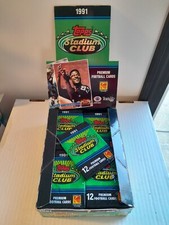


Stadium Club arrived in football in 1991 as Topps' answer to the premium card boom, with full-bleed photography, gloss on both sides and no team logos cluttering the fronts. It ran through 2002, returned once in 2008 and has not been made for football since, which means the entire line is a closed set of roughly thirteen years of wax sitting in the junk wax era and just past it. The 1991 box carries a Brett Favre rookie card and that single fact drives most of the demand for sealed Stadium Club football today.
Buy Topps Stadium Club Football sealed
All listings on eBay →Prices update daily from live eBay listings. Prefer to buy in person? Find a local card shop · All NFL sealed

Quick facts
| Brand | Topps |
| First year | 1991 |
| Release window | Historically midseason for Series 1 with a later Series 2 in the mid-1990s |
| License | NFL and NFLPA licensed throughout; Topps' football license ended after the 2015 season |
| Box formats | Hobby and retail wax boxes, series-split boxes in the 1990s, jumbo packs, 2008 hobby boxes with autographs |
| Guaranteed hits | None in the 1990s configurations; the 2008 revival carried autograph and relic content |
| 1991 hobby box (Aug 2026) | Roughly $125-$275, wide spread |
Box formats for Stadium Club Football
1991 wax box
The debut year is the format most people are buying. A 1991 Stadium Club football box is 36 packs of 12 cards, and the base set runs 500 cards released across series. There are no autographs, no relics and no numbered parallels; the entire value proposition is the Brett Favre rookie at card 94, which is famous a second time over for spelling his name "Farve" on the back. Ricky Watters also has a rookie in the set, and Emmitt Smith, Joe Montana and Barry Sanders anchor the veteran run. Topps also produced a 300-card subset reprinted with an embossed Super Bowl XXVI logo for distribution at that game, and those cards trade at a large premium to the base versions in high grade.
Mid-1990s series boxes
From 1992 through the late 1990s Stadium Club football split into Series 1 and Series 2, sometimes with a third series, and boxes were sold in both hobby and retail channels with different insert seeding. Hobby boxes are the ones worth buying sealed, because the scarcer inserts were hobby-weighted. Configurations shifted year to year, generally landing between 24 and 36 packs of 8 to 12 cards.
1998 through 2002 boxes
The later 1990s issues moved toward smaller print runs, thicker card stock and more serious insert programs, and they carry the rookie classes that matter most to modern collectors. Boxes from this stretch are harder to find sealed than 1991 or 1992 wax because production had come down sharply from the peak.
2008 hobby box
Stadium Club returned for one year in 2008 with a modern configuration built around on-card autographs and relic content rather than a large base set. It is the only Stadium Club football product with guaranteed hits, and it is the one year that behaves like a modern box rather than a wax box.
Key years: prices and cards that matter
| Year | Sealed box (Aug 2026) | What is in it |
|---|---|---|
| 1991 | $125-$275 | Brett Favre RC (the "Farve" error back), Ricky Watters RC, Super Bowl XXVI parallel subset |
| 1993 | $70-$150 | Drew Bledsoe and Jerome Bettis rookie season; heavy print run |
| 1998 | $150-$325 | Peyton Manning and Randy Moss rookie class, the strongest late-1990s year |
| 1999 | $90-$200 | The 1999 quarterback class, headed by Donovan McNabb and Daunte Culpepper |
| 2001 | $80-$180 | The 2001 draft class of Michael Vick, LaDainian Tomlinson and Drew Brees |
| 2008 | $60-$140 | The only Stadium Club football year with guaranteed autographs and relics |
Treat every figure here as an approximation. Sealed Stadium Club football boxes trade in small numbers, condition varies enormously, and authenticated wax sells at a completely different level from a box a seller simply calls sealed. The two years that carry the line are 1991 for Favre and 1998 for Manning and Moss. Everything in between is junk wax era production, printed in enormous quantities, and the boxes are worth buying to open rather than to hold. The 2008 box is the outlier in the other direction: modern, low print run, but with a rookie class that never produced a genuine star card, so it stays cheap.
Chase cards, parallels and hit rates
Stadium Club football's identity was photography rather than hits, and its insert programs reflect that. First Day Issue is the signature parallel of the 1990s run, a stamped version of the base card produced in far smaller quantities and the card that separates a serious Stadium Club collector from a casual one. Members Only parallels, distributed through Topps' collector club rather than packs, are the other scarce tier and are frequently misidentified in listings. Insert sets rotated year to year and included die-cut and foil-heavy chases in the mid-1990s.
Autographs did not exist in the line until 2008, when Topps rebuilt the brand around on-card signatures. That is the single most important thing to understand before buying older sealed wax: a 1991 through 2002 box will not produce a hit, and its entire value sits in base rookies, First Day Issue parallels and the condition of what you pull. Anyone quoting you autograph odds for a 1990s Stadium Club football box is describing a product that does not exist.
Is Stadium Club football worth buying sealed?
For 1991, yes, if you buy it right. A box holds 432 cards and roughly a dozen shots at a Favre rookie in raw condition, and PSA 10 examples of that card carry a large premium over ungraded copies because the gloss chips and the corners are soft out of the pack. That is a real, if long, path to value. For the rest of the 1990s the answer is generally no: the print runs were enormous, the base cards are worth cents, and the boxes are entertainment. The 1998 box is the exception on the strength of Manning and Moss. As a brand-level bet, Stadium Club football has one thing going for it that most junk wax does not, which is that Topps has kept the name alive in baseball and could plausibly revive it for football now that it holds NFL rights again; a revival would put the old wax back in front of a new audience.
How to spot fakes and resealed boxes
Wax from this era is the most heavily resealed material in the hobby, and Stadium Club is a prime target because the Favre box is worth several times a common box. Look at the cellophane first: original factory wrap from the early 1990s has soft, uneven seams and yellows with age, while a modern reseal is bright, tight and often has a perfectly straight heat seam. Check that the box flaps have no glue residue or lifted cardboard. A box with all 36 packs present but slightly uneven pack alignment has usually been opened and repacked. For anything you are paying real money for, insist on a box authenticated by a recognized wax authenticator such as BBCE, which examines the seams and applies its own tamper-evident wrap; authenticated boxes routinely trade at a meaningful premium to unauthenticated ones and that premium is the cheapest insurance available. Individual packs are even easier to search and reseal than boxes, so treat loose 1991 packs with more suspicion, not less.
Where to buy Stadium Club football sealed
Junk wax era boxes sit in the back rooms of shops that carry vintage and 1990s wax more often than they appear online, and shop pricing is frequently below eBay because the boxes have been there for years. Card shows are the single best venue for this material, because you can handle the box, check the seams and negotiate. Online, these searches keep the results tight:
Frequently asked questions
Is Topps Stadium Club football still made?
No. The football line ran from 1991 through 2002 and returned once in 2008. Topps' NFL license ended after the 2015 season, and no football Stadium Club has been announced since Topps regained NFL rights in April 2026.
What is in a 1991 Topps Stadium Club football box?
Thirty-six packs of twelve cards from a 500-card base set, with no autographs or relics. The reason to buy it is the Brett Favre rookie card, number 94, which is also known for the "Farve" misspelling on the back.
How much is a 1991 Stadium Club football box worth?
Boxes sold for roughly $125-$275 in August 2026, with authenticated boxes going above unauthenticated ones. Ranges are wide because sales are infrequent and reseal risk is priced into the market.
Which Stadium Club football year is the best buy?
1991 for the Favre rookie and 1998 for the Peyton Manning and Randy Moss class. The years in between were printed in very large quantities and are worth opening rather than holding.
Are there autographs in Stadium Club football?
Only in the 2008 revival, which was built around on-card autographs and relics. No box from 1991 through 2002 contains autograph or memorabilia cards.
What is a First Day Issue card?
A stamped parallel of the base card produced in far smaller numbers than the regular version. It is the signature scarce parallel of 1990s Stadium Club and is often confused with the Members Only club parallel.
Related sets
Prices in this guide were last reviewed 2026-08. Live eBay listings above update daily.