Fleer Ultra Basketball: Sealed Box Prices, Key Seasons and Gold Medallions
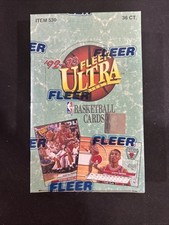

Ultra was Fleer's step-up brand, positioned above the flagship set with thicker stock, foil treatments and the Gold Medallion parallel that became the line's signature. Basketball Ultra debuted in 1992-93, ran almost every season through 2004-05, and returned twice under Upper Deck after the Fleer acquisition. Sealed Ultra is one of the more approachable ways into 1990s basketball wax, with a huge spread between the Kobe-era boxes and the mid-2000s issues that still sell for double figures.
Buy Fleer Ultra Basketball sealed
All listings on eBay →Prices update daily from live eBay listings. Prefer to buy in person? Find a local card shop · All NBA sealed
Quick facts
| Brand | Fleer (Upper Deck-produced from 2005-06 onward) |
| First season | 1992-93 |
| Release window | Series 1 in the fall, Series 2 mid-season, through 1998-99 |
| License | NBA licensed throughout; Fleer folded in 2005, Upper Deck issued the final editions |
| Box formats | Hobby, retail, Series 1 and Series 2, jumbo packs, cases |
| Guaranteed hits | None in the 1990s; roughly one memorabilia card per box by 2006-07 |
| 2006-07 hobby box (Aug 2026) | Roughly $100-$160 |
Box formats for Fleer Ultra
Hobby Box
The core format. Configurations changed with the era: 1990s Ultra typically ran 36 packs, the 2006-07 edition is 24 packs of eight cards with about one game-used memorabilia card per box on average. Hobby boxes carry the full insert lineup and, in the later years, the hobby-only Platinum Medallion parallels numbered as low as 14 copies. Where a season split into two series, the hobby box for the series holding the rookie cards commands the premium.
Series 1 and Series 2
Through 1998-99, Ultra basketball split into two series. Series 1 carried veterans and the early-season checklist; Series 2 added rookies who signed after the first print run. For 1996-97 that split matters: Kobe Bryant, Allen Iverson and Ray Allen appear in Series 1, while Ben Wallace and Derek Fisher landed in Series 2. Both trade in four figures today, and Series 2 boxes have at times listed higher despite the lesser rookie names, purely on scarcity.
Retail and Jumbo
Retail Ultra boxes used shorter packs and skipped the hobby-exclusive parallels. Jumbo or "super" packs held more cards and, in the mid-2000s editions, were the only route to certain Platinum Medallion and multi-swatch jersey cards. Retail is cheaper but is also the format most often searched and resealed.
Case
Ultra cases ran 12 to 20 hobby boxes depending on the season. Sealed 1990s cases barely surface any more, and when one does it trades by negotiation rather than by a published comp.
Key seasons: prices and key rookies
| Season | Hobby box range (Aug 2026) | Notes | Key rookies / chase |
|---|---|---|---|
| 1992-93 | Roughly $250-$600 | First Ultra basketball | Shaquille O'Neal, Alonzo Mourning |
| 1996-97 | Series 1 roughly $1,500-$2,200; Series 2 roughly $2,200-$4,000 | The line's peak season | Kobe Bryant, Allen Iverson, Ray Allen, Steve Nash |
| 1997-98 | Roughly $600-$1,200 | Star Power, Fresh Ink era | Tim Duncan, Tracy McGrady, Chauncey Billups |
| 1998-99 | Roughly $500-$1,000 | Lockout-shortened print | Vince Carter, Dirk Nowitzki, Paul Pierce |
| 2003-04 | Roughly $400-$900 | LeBron class | LeBron James, Dwyane Wade, Carmelo Anthony, Chris Bosh |
| 2006-07 | Roughly $100-$160 | Last widely stocked edition | Brandon Roy, LaMarcus Aldridge, Rajon Rondo |
The investment seasons are the ones tied to a generational rookie class. 1996-97 is the clear leader and has repriced sharply as Kobe material has been chased; 1997-98 and 1998-99 follow. The 2003-04 edition is interesting because it sits in a period when print runs were falling and every product carried the LeBron rookie, so box prices stayed moderate while singles ran away. These ranges are indicative rather than precise: sealed Ultra changes hands infrequently enough that a single motivated bidder can move a season's apparent price by a wide margin.
Chase cards, parallels and hit rates
Gold Medallion is the parallel that defines Ultra. It is a full parallel of the base set with gold foil, found at pack odds rather than serial numbering in the 1990s, and it is the card that Ultra collectors register sets around. Platinum Medallion arrived later as the scarce tier, serial numbered in the mid-2000s editions to as few as 14 copies and restricted to hobby. Above those sit the insert sets that carry the line's reputation: Court Masters, Rising Stars, Starring Role and Scoring Kings, all long-odds pulls in the 1:180 to 1:280 pack range in the 1990s issues. Autographs came late to Ultra, arriving through Fresh Ink, and memorabilia through Kings of the Court. Do not expect a 1990s Ultra box to produce a hit in the modern sense; the value is in the base rookies and the tough inserts.
Is Fleer Ultra worth buying sealed?
Ultra sits in a useful middle ground. It is scarce enough that boxes are genuinely hard to find in the strong seasons, but it was printed heavily enough that you are not paying Metal Universe or Flair Showcase money. The case for buying is a 1996-97, 1997-98 or 1998-99 box and holding it as intact wax, since supply only shrinks. The case against opening is straightforward: Ultra base cards from those years are common and grade poorly because of foil chipping, so the break math rarely works. Mid-2000s Ultra is cheap for a reason, with soft checklists and redemption cards that Fleer never honored after the company shut down in 2005. Buy that tier to open for fun, not to hold.
How to spot fakes and resealed boxes
Ultra boxes from the 1990s were shrink-wrapped rather than tape-sealed, which makes resealing easy and detection a matter of inspecting the film. Factory shrink of that era is thin and tight with a small seam weld, usually on one end; replacement wrap tends to be thicker, glossier and loose at the corners. Check that the box flaps have not been slit and reglued, and look at the pack tops through the film for tool marks. Series 2 boxes are frequently mislabeled or misrepresented as Series 1 in listings, so verify the box art rather than the title. For anything from 1992-93 through 1998-99, a Baseball Card Exchange authentication or a comparable third-party opinion is worth the premium, because searched-and-rewrapped Ultra is common and effectively impossible to detect from a listing photo.
Where to buy Fleer Ultra sealed
Shops that carry 1990s wax usually have a shelf of Ultra priced below auction levels. Card shows are the best venue for 1996-97 boxes, where dealers move them without the fees that inflate online results. Useful eBay strings:
Frequently asked questions
What seasons was Fleer Ultra basketball produced?
Ultra basketball ran from 1992-93 through 2004-05, then returned for 2006-07 and 2007-08 under Upper Deck after it acquired the Fleer brands. There was no 2005-06 edition.
How much is a 1996-97 Fleer Ultra basketball box?
In August 2026 a Series 1 hobby box was worth roughly $1,500-$2,200 and Series 2 roughly $2,200-$4,000. Both ranges are wide because sealed boxes trade infrequently.
Is Fleer Ultra basketball still made?
No. Fleer Corp. closed in May 2005, Upper Deck bought the brands and released the final Ultra basketball editions, and no Ultra NBA product has been made since 2007-08.
What is a Gold Medallion card?
Gold Medallion is Ultra's signature parallel, a gold-foil version of the base set inserted at pack odds. Platinum Medallion is the later, much scarcer serial-numbered tier found in hobby boxes.
Which Fleer Ultra basketball season is the best to buy sealed?
1996-97 for the Kobe Bryant, Allen Iverson and Ray Allen rookie class, followed by 1997-98 for Duncan and McGrady and 1998-99 for Carter, Nowitzki and Pierce.
Are Fleer Ultra boxes often resealed?
Yes, often enough to matter. The shrink wrap used in the 1990s is easy to replicate, so buy authenticated boxes where you can and inspect film seams, flap edges and pack tops closely where you cannot.
Prices in this guide were last reviewed 2026-08. Live eBay listings above update daily.