Fleer Basketball: Sealed Wax Box Prices and the 1986-87 Jordan Box
Fleer relaunched NBA cards in 1986-87 after a five-year gap in the licensed basketball market, and the wax box from that first year is the most valuable sealed product in the hobby because of one card: the Michael Jordan rookie. The flagship ran under the Fleer name through 1997-98, continued as Fleer Tradition, then returned briefly at the end of the brand's life. This page covers the sealed formats, what the key seasons trade for, and why authentication decides most of the price.
Buy Fleer Basketball sealed
All listings on eBay → 1990-91 Wax Pack
$3.99
1990-91 Wax Pack
$3.99
 1989-90 Wax Pack
$5.55
1989-90 Wax Pack
$5.55
 1988-89 Wax Pack
$5.99
1988-89 Wax Pack
$5.99
 1992-93 Wax Pack
$10.84
1992-93 Wax Pack
$10.84
 1987-88 Wax Pack
$18.00
1987-88 Wax Pack
$18.00
 1990-91 Wax Box
$93.60
1990-91 Wax Box
$93.60
 1986-87 Wax Pack
$399.99
1986-87 Wax Pack
$399.99
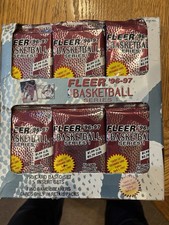 1996-97 Retail Box
$1,100.00
1996-97 Retail Box
$1,100.00
 1989-90 Wax Box
$1,500.00
1989-90 Wax Box
$1,500.00
 1996-97 Hobby Box
$2,999.99
1996-97 Hobby Box
$2,999.99
 1988-89 Wax Box
$9,850.00
1988-89 Wax Box
$9,850.00
Prices update daily from live eBay listings. Prefer to buy in person? Find a local card shop · All NBA sealed

Quick facts
| Brand | Fleer (Fleer Corp. through 2005, then Upper Deck-owned) |
| First season | 1986-87 |
| Release window | Fall, with 1980s sets arriving well into the season |
| License | NBA licensed from 1986-87; Fleer folded in 2005 and Upper Deck issued the last Fleer-branded NBA sets |
| Box formats | Wax box (36 packs), cello box, rack packs, jumbo packs, cases |
| Guaranteed hits | None; one sticker per wax pack |
| 1986-87 wax box (Aug 2026) | Roughly $100,000-$250,000 for a BBCE-authenticated example |
Box formats for Fleer Basketball
Wax Box
The classic format and the one the market prices. A 1986-87 Fleer wax box holds 36 packs, each with 12 cards and one of the 11 Super Star Stickers. The set is 132 cards, so a box yields well over two full sets plus, on average, two to three Jordan #57 rookies and a handful of Jordan #8 stickers. The same 36-pack architecture carried through Fleer's later 1980s and early 1990s basketball issues, but only 1986-87 through 1988-89 have real money attached.
Cello Box and Rack Packs
Cello and rack formats were retail products with cards visible through clear wrap. Collectors pay premiums when a Jordan shows on the top or bottom card of a sealed cello pack, which also makes these the formats most often manipulated. Sealed 1986-87 cello trades thinly, so treat any listing as a one-off negotiation rather than a market price.
Wax Case
Sealed 1986-87 cases essentially do not come to market. A 12-box unopened case sold at auction in August 2020 for $1,789,717 including premium, roughly $149,000 per box, and that sale is still the reference point collectors cite when arguing what an authenticated single box is worth.
Later Fleer-branded hobby boxes
The Fleer name returned for 2006-07 through 2008-09 under Upper Deck. The 2006-07 hobby box is 36 packs of 10 cards with a memorabilia card per box on average, and it is best known for inserting autographed 1986-87 Fleer buyback cards, signed Jordan rookies included. Distributors have quoted buy prices near $2,500, so the buyback lottery drives the value.
Key seasons: prices and key rookies
| Season | Sealed box range (Aug 2026) | Pack / other | Key rookies and chase |
|---|---|---|---|
| 1986-87 | $100,000-$250,000+ (BBCE authenticated) | Single packs $2,500-$9,500 | Michael Jordan #57, Barkley, Olajuwon, Ewing, Malone, Drexler |
| 1987-88 | Roughly $10,000-$22,000, very thin | Packs around $400-$550 | Second-year Jordan; Jordan sticker |
| 1988-89 | Roughly $5,000-$10,000, very thin | Packs around $200-$275 | Pippen, Stockton, Reggie Miller, Rodman |
| 1989-90 | Roughly $1,100-$2,000 | Packs $25-$40 | Sean Elliott, Tim Hardaway era; Jordan base |
| 1990-91 | Roughly $175-$325 | Packs $5-$10 | Overproduced junk-wax season |
| 2006-07 | Roughly $2,200-$3,500 | -- | Roy, Aldridge, Rondo; Jordan buyback autographs |
Read every one of these ranges as wide. Vintage basketball wax is a thin market with few comparable sales in any month, and the same 1986-87 box trades at very different numbers depending on who authenticated it, whether the packs are described as tight and unsearched, and whether a Jordan is showing. The seasons that matter are 1986-87 first and everything else a distant second: 1987-88 and 1988-89 have genuine scarcity behind them, while 1990-91 onward is junk-wax-era production where boxes are cheap and will stay cheap.
Chase cards, parallels and hit rates
The 1980s Fleer sets have no parallels or serial numbering. Value sits entirely in the Jordan rookie at #57, the Jordan #8 sticker, and the deep rookie classes of 1986-87 and 1988-89. Because the checklist is short, breaks produce multiples of every card, so the chase is not a rare pull but a high grade. PSA 10 Jordan rookies are what make a break profitable, and centering, print snow and edge chipping on the red-white-blue borders make that grade brutally hard to hit. That math is why so many authenticated boxes stay sealed. Later Fleer-branded product added Gold Medallion-style parallels, Fresh Ink autographs and jersey cards, none of which approaches the 1980s cards in value.
Is Fleer Basketball worth buying sealed?
The 1986-87 box is a store of value rather than a break. Grading returns almost never justify opening one at current prices, and the box is worth more intact and authenticated than the cards inside would bring. That dynamic is self-reinforcing, and it is why supply keeps shrinking. For 1987-88 and 1988-89 there is a real argument for breaking, since Pippen, Stockton, Miller and Rodman rookies grade better than 1986-87 Jordans and boxes cost a fraction as much, but you are still paying scarcity pricing on thin comps. From 1989-90 forward, sealed Fleer basketball is a nostalgia purchase.
How to spot fakes and resealed boxes
Assume any 1980s Fleer basketball box without third-party authentication is suspect. Baseball Card Exchange is the accepted authority: a BBCE box is examined, then sealed in BBCE shrink with a serial-numbered label and a letter of authenticity, and the market pays a substantial premium for that over raw sealed. Resealers reproduce vintage wrap convincingly, so look at pack seams rather than the box. Original Fleer wax packs show crimped, slightly irregular end folds and gum residue transfer; resealed packs look too even and too clean. On boxes, check the interior flap tuck, the printing registration on the box art and whether the shrink film matches the era. Searched boxes are the more common problem: one picked through for Jordan-showing packs and rewrapped presents as sealed while holding only leftovers. If a seller will not send close photos of the seal, corners and pack tops, walk away.
Where to buy Fleer Basketball sealed
Vintage wax is a relationship business. Shops that handle unopened material can source it and will tell you what has been picked over. Card shows are where most raw sealed 1980s basketball changes hands. Online, keep searches tight:
Frequently asked questions
How much is a 1986-87 Fleer basketball wax box worth?
Roughly $100,000 to $250,000 for a BBCE-authenticated 36-pack box in the August 2026 market. Price guides have carried figures near $130,000 while a recent auction result cleared $239,850, so treat any single number with caution.
Is Fleer basketball still made?
No. Fleer Corp. shut down in May 2005, Upper Deck acquired the brands, and the last Fleer-branded NBA sets appeared in the 2006-07 through 2008-09 seasons. No Fleer or SkyBox NBA product has been produced since.
Which Fleer basketball seasons are worth buying sealed?
1986-87 for the Jordan rookie, and 1987-88 and 1988-89 for scarcity and strong rookie classes. From 1989-90 onward, production was heavy and boxes trade for modest sums.
What does BBCE authentication mean for a Fleer basketball box?
Baseball Card Exchange inspects the box and packs, then reseals it in its own shrink with a numbered label and a letter of authenticity. Authenticated boxes trade at a clear premium because they carry an expert opinion that the wax was not searched.
How many Jordan rookies are in a 1986-87 Fleer box?
There is no guarantee. A 36-pack box holds 432 cards from a 132-card set, so a box averages two to three Jordan #57 rookies plus several #8 Jordan stickers, though collation varied.
Was Fleer ever licensed by the NBA?
Yes, from 1986-87 onward, for two decades. The license moved to Upper Deck with Fleer's assets in 2005, and Upper Deck itself exited NBA cards after 2009-10.
Related sets
Prices in this guide were last reviewed 2026-08. Live eBay listings above update daily.