SkyBox Basketball: Sealed Box Prices, Seasons and the SkyBox Family
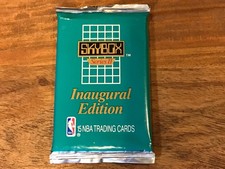

SkyBox arrived for 1990-91 as the first NBA card set printed on white stock with no borders and abstract computer-generated backgrounds, and it looked like nothing else on the shelf. The plain SkyBox flagship ran three seasons before the name shifted to SkyBox Premium, but SkyBox International went on to become the umbrella for E-X, Z-Force, Molten Metal and much of the Fleer premium catalogue. Sealed SkyBox from the early 1990s is cheap, plentiful and a genuinely fun break; the later revival is a different animal entirely.
Buy SkyBox Basketball sealed
All listings on eBay →Prices update daily from live eBay listings. Prefer to buy in person? Find a local card shop · All NBA sealed
Quick facts
| Brand | SkyBox International, acquired by Fleer in 1995 |
| First season | 1990-91 |
| Release window | Series 1 in the fall, Series 2 mid-season |
| License | NBA licensed from 1990-91; the last SkyBox-branded NBA product was 2008-09 under Upper Deck |
| Box formats | 36-pack wax boxes in the early seasons, hobby boxes later, cases |
| Guaranteed hits | None in the early 1990s; roughly three memorabilia and one autograph per box in 2008-09 |
| 1990-91 Series 1 box (Aug 2026) | Roughly $85-$130 |
Box formats for SkyBox
Wax Box (1990-91 to 1992-93)
The early SkyBox boxes hold 36 packs of 15 cards, which by junk-wax standards is a lot of cardboard. The 1990-91 set is 423 cards across two series, so a box will not build a set on its own but will get you most of the way. There are no inserts in the modern sense; the appeal is the design, the Jordan base card at #41 and the rookie run of Gary Payton, Shawn Kemp, Tim Hardaway, Vlade Divac and Drazen Petrovic.
Series 1 and Series 2
Series 1 covers cards #1-300 and Series 2 covers #301-423, but Series 2 packs mix in Series 1 cards, and some Series 1 players were dropped to make room, creating short prints across the run. That collation quirk is why set builders still buy Series 2 boxes. Both series trade in roughly the same band.
Retail and Hobby (later seasons)
By the mid-1990s the SkyBox name had moved to SkyBox Premium and the sealed market for it is covered separately. The 2008-09 SkyBox revival, produced by Upper Deck, is a 12-pack hobby box of 10 cards with about three memorabilia cards and one autograph per box, released February 2009 and limited to a stated 375 numbered cases.
Case
Early-1990s SkyBox cases of 20 boxes still turn up intact because nobody bothered breaking them. They trade at a small discount to the sum of the boxes and are a cheap way to own a lot of sealed wax, provided you have somewhere to put it.
Key seasons: prices and key rookies
| Season | Sealed box range (Aug 2026) | Notes | Key rookies / chase |
|---|---|---|---|
| 1990-91 | Series 1 roughly $85-$130; Series 2 roughly $85-$115 | 36 packs of 15 | Gary Payton, Shawn Kemp, Tim Hardaway, Drazen Petrovic; Jordan #41 |
| 1991-92 | Roughly $45-$95 | Heavier print run | Dikembe Mutombo, Larry Johnson, Steve Smith |
| 1992-93 | Roughly $40-$90 | Peak junk-wax volume | Shaquille O'Neal, Alonzo Mourning |
| 2008-09 | Roughly $150-$400, thin | Upper Deck revival, 375 cases | Derrick Rose, Russell Westbrook, Kevin Love |
None of the early SkyBox seasons is an investment. They were printed in enormous quantities and the boxes have traded in double figures for decades. What they offer is a genuinely enjoyable break at a low price and the chance to grade the handful of cards that matter, which is a real consideration because white-bordered SkyBox cards show handling damage badly and PSA 10s of the Payton and Kemp rookies are much scarcer than the print run suggests. The 2008-09 revival is the opposite case: it was produced in tiny quantities against a strong rookie class, so sealed boxes trade well above their release price, but the market for them is thin and prices bounce.
Chase cards, parallels and hit rates
The 1990-91 through 1992-93 sets have no serial numbering and no autographs. The most valuable pieces from 1990-91 are actually the prototype and promo cards produced ahead of the release, particularly Jordan and Magic Johnson versions, which never came out of packs. Within packs, the chase is the Jordan base card and the rookie run, plus a handful of documented variations such as the Dennis Rodman #91 logo placement and the Antoine Carr #244 jersey variation. The 2008-09 revival runs a modern structure of numbered parallels to 10, 25 and 50, patch memorabilia and on-card autographs. If you want SkyBox with genuine hit content from the 1990s, look to SkyBox Premium, E-X and Z-Force rather than the flagship.
Is SkyBox worth buying sealed?
For the early seasons, buy it to open. A 1990-91 box at around $100 gives you 540 cards, a nostalgic design that has aged well and a real shot at a gradable Payton or Kemp rookie. It is one of the best-value breaks in vintage basketball, and nobody should be buying it as a store of value. The 2008-09 box is a speculation on a small print run and the Rose and Westbrook rookie market, and it carries the usual risk of any thin, low-volume product: you may not find a buyer quickly. Between the two sits a decade of SkyBox-family product under other names, most of which is more interesting than either.
How to spot fakes and resealed boxes
Counterfeiting is not the risk with junk-wax SkyBox; the boxes are worth too little to bother. Searching and reselling is still a nuisance, mostly around promo and prototype cards, so check that shrink wrap is factory-tight with a proper seam weld rather than loose replacement film, and that the box flaps have not been slit. Boxes stored in garages and lofts for thirty years often show water staining or crushed corners that a listing photo hides, so ask for pictures of all six sides. Series 1 and Series 2 boxes are routinely mislabeled, so read the box art rather than the title. For the 2008-09 revival, verify the case number and the Upper Deck holographic seal, since that product is expensive enough to be worth faking.
Where to buy SkyBox sealed
Early-1990s SkyBox sits in bargain bins at most shops that handle vintage, and shop prices are usually better than online once shipping is counted. Card shows are where you will find whole cases at a discount. Search strings:
Frequently asked questions
What seasons was SkyBox basketball produced?
The plain SkyBox flagship ran 1990-91, 1991-92 and 1992-93, after which the name moved to SkyBox Premium. Upper Deck revived the SkyBox name for a single 2008-09 basketball release.
How much is a 1990-91 SkyBox basketball box?
Series 1 boxes sold for roughly $85-$130 and Series 2 for roughly $85-$115 in August 2026. These are junk-wax-era boxes and prices have been stable for years.
Is SkyBox basketball still made?
No. SkyBox International was acquired by Fleer in 1995, Fleer closed in 2005, and the last SkyBox-branded NBA product was the 2008-09 release issued by Upper Deck.
What are the best cards in 1990-91 SkyBox?
The Michael Jordan base card at #41 and the rookie run of Gary Payton, Shawn Kemp, Tim Hardaway, Vlade Divac and Drazen Petrovic. The scarcest pieces are the promo and prototype cards, which were never in packs.
Are SkyBox boxes worth opening?
Yes, at these prices. A 36-pack box costs about what a modern retail blaster does, and the white borders chip and ding easily, so high-grade examples of the key rookies are scarcer than the print run implies.
What is the difference between SkyBox and SkyBox Premium?
They are the same brand line at different points. SkyBox was the flagship name through 1992-93; from 1993-94 the flagship was branded SkyBox Premium and carried inserts, parallels and, later, autographs.
Related sets
Prices in this guide were last reviewed 2026-08. Live eBay listings above update daily.