Topps Museum Collection Football: Boxes, Hits and 2013-2014 Prices
Topps Museum Collection is one of the shortest-lived premium football brands Topps ever ran: two seasons, 2013 and 2014, both hobby-only, both built on the same five-hits-in-twenty-cards structure that made the baseball version a fixture. It arrived late in Topps' NFL run and disappeared when that license ended after the 2015 season, which leaves a small, closed universe of boxes and a checklist that happens to include one of the strongest rookie classes of the decade. If you are pricing a Topps Museum Collection football hobby box, this page covers what is inside, what the two years are worth and why the 2014 edition is the one people chase.
Buy Topps Museum Collection Football sealed
All listings on eBay →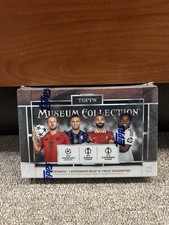
Prices update daily from live eBay listings. Prefer to buy in person? Find a local card shop · All NFL sealed
Quick facts
| Brand | Topps |
| First year | 2013 |
| Release window | Late in the calendar year following the season; the 2014 edition shipped in December 2014 |
| License | NFL and NFLPA licensed; Topps' football license ended after the 2015 season |
| Box formats | Hobby box and 12-box hobby case only |
| Guaranteed hits | Five per box: one autographed relic, one autograph, one jumbo relic, one quad relic and one Canvas Collection card |
| 2014 hobby box (Aug 2026) | Roughly $425-$775, thin sales |
Box formats for Topps Museum Collection Football
Hobby Box
The only configuration that matters. A box is four packs of five cards, twenty cards in total, and each pack delivers a different style of card so the box opens as a sequence rather than a pile. The guaranteed contents are one autographed memorabilia card, one standalone autograph, one jumbo relic, one quad relic and one Canvas Collection insert, with base parallels filling the remainder. There was no retail version, no blaster and no mega; Museum Collection football was distributed to hobby shops only, which is one reason sealed boxes are comparatively scarce today for a product this recent.
Hobby Case
A case is twelve hobby boxes, and it is the unit at which the scarcest content is seeded. Framed Autographs, with signatures on cards set into metal frames, and Jumbo Patch Autographs of rookies were case-level pulls rather than box guarantees in both years. Buyers who want a realistic shot at those cards buy cases, and dealers who break the product tend to price single boxes as though the case hits have already been removed, which is worth remembering when you compare a shop's box price to a case price divided by twelve.
Recent years: prices and key rookies
| Year | Hobby box (Aug 2026) | Case (Aug 2026) | Key rookies / chase |
|---|---|---|---|
| 2014 | $425-$775 | $5,000-$8,500 | Odell Beckham Jr., Derek Carr, Mike Evans, Davante Adams, Jimmy Garoppolo, Teddy Bridgewater |
| 2013 | $300-$550 | $3,500-$6,000 | Travis Kelce, DeAndre Hopkins, Le'Veon Bell, Keenan Allen, Geno Smith, Tavon Austin |
Treat both ranges as approximate. Museum Collection football boxes trade infrequently enough that a month can pass without a public sale, spreads between asks and completed sales are wide, and a single case break can move the market for weeks. What is not in doubt is the ordering: 2014 sits above 2013 because of the rookie class. Odell Beckham Jr. was the defining rookie of that draft for card collectors, and Derek Carr, Mike Evans and Davante Adams all built long careers on top of him. The 2013 class looked weak at the time and aged unusually well, with Travis Kelce and DeAndre Hopkins turning into the two most valuable names on a checklist that originally led with Geno Smith and E.J. Manuel. That mismatch between original hype and eventual value is the main reason 2013 boxes are still findable at sensible money.
Chase cards, parallels and hit rates
The base set in both years was only 100 cards, split across current stars, key rookies and retired greats, with one parallel per pack. The parallel ladder runs Copper, then Sapphire numbered to 99, Ruby numbered to 50 and Emerald as a one-of-one, and it is shallow by design because the product is sold on its hits rather than its rainbow.
Canvas Collection is the signature insert: painted reproductions of players printed on canvas stock, one per box, with original hand-painted one-of-one artwork cards as the top tier. Signature Series Autographs carry roughly 50 players per year with on-card signatures and numbered parallels down to Emerald 1/1. The premium pulls are Framed Autographs, where the signature sits inside a metal frame, and Jumbo Patch Autographs of rookies, which are the cards that carry a 2014 Beckham or Carr box. Quad Relics appear in rookie, Pro Bowl and four-player configurations, and the specialty relics, meaning laundry tags, NFL shields and logo patches, are one-of-ones. Topps published odds on the pack wrappers in both years; anything quoted online as a precise pull rate for a specific player should be checked against the wrapper rather than trusted.
Is Topps Museum Collection football worth buying sealed?
The honest answer is that it is a collector's product rather than an investment vehicle. Five hits per box sounds generous, but two of them are relics from a period when relic cards had already lost most of their resale value, so the expected return on an average box is well below its cost unless the autograph is a rookie who mattered. What supports the line is scarcity: hobby-only distribution, two years of production, no reprints, and a license that closed after 2015. Nothing new will ever be added. Within that, 2014 is the better hold on the strength of the Beckham class, and 2013 is the better break if you simply want to open a premium box without paying premium money. Buy cases if you specifically want the framed and jumbo patch autographs; buy single boxes only if you accept that those cards have usually already been pulled from the case.
How to spot fakes and resealed boxes
Museum Collection boxes are small, heavy and easy to reseal, which makes inspection worthwhile. Genuine boxes are shrink wrapped tightly with a factory seam along the bottom and a Topps tamper-evident seal beneath the wrap; loose or baggy wrap, a seam that runs up a side, or adhesive residue at the flap are all reasons to walk. Because the packs inside are individually distinguishable by what they contain, a searched box can have a single pack removed and replaced, so count the packs in any photo. Weighing does not help at this tier because every card in the box is roughly the same weight. With so few public sales, an unusually cheap listing is more likely to be a problem than a bargain, and buying from a shop that will open the box in front of you removes the question entirely.
Where to buy Topps Museum Collection football sealed
Shops that carried Topps football before 2016 often still have old premium stock in the back, and it is usually priced from an older guide rather than today's market, so the card shop directory is the first place to look. Card shows are the most reliable venue for a product this thinly traded, because dealers who bought cases a decade ago bring them out to move. Online, these searches keep the noise down:
Frequently asked questions
Is Topps Museum Collection football still made?
No. The football edition ran for two years, 2013 and 2014. Topps' NFL license ended after the 2015 season, and when Topps returned to football in 2024 it did not revive the brand for the sport.
What comes in a Topps Museum Collection football hobby box?
Four packs of five cards, twenty cards total, with five guaranteed hits: an autographed relic, an autograph, a jumbo relic, a quad relic and a Canvas Collection card.
How much is a Topps Museum Collection football box worth?
Roughly $425-$775 for 2014 and $300-$550 for 2013 as of August 2026, but sales are infrequent and the ranges are wide. Cases carry a premium because the framed and jumbo patch autographs are case-level pulls.
Which year of Museum Collection football is better?
2014, because of the Odell Beckham Jr. rookie class alongside Derek Carr, Mike Evans and Davante Adams. 2013 is cheaper and has aged well through Travis Kelce and DeAndre Hopkins.
What is a Canvas Collection card?
A painted reproduction of a player printed on canvas stock, inserted one per box, with original one-of-one hand-painted artwork cards as the top tier of the insert.
Was Museum Collection football sold at retail?
No. It was a hobby-only product, sold as single boxes and twelve-box cases through hobby distribution, with no blaster, mega or hanger configuration.
Related sets
Prices in this guide were last reviewed 2026-08. Live eBay listings above update daily.