Topps Platinum Football: Sealed Box Prices and Rookie Autographs
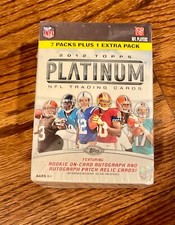


Topps Platinum was the chrome-adjacent mid-range football product of the early 2010s: a hobby-only box built around on-card rookie autographs, refractor rookie cards and a deep die-cut parallel ladder, priced well below Topps' premium lines but delivering three autographs a box in most years. Set databases list football issues from 2009 through 2014, and it disappeared with the rest of Topps' football catalog when the company's NFL license ended after the 2015 season. It has since become one of the better-value ways to buy sealed rookie autograph product from a stretch that produced Andrew Luck, Russell Wilson and Odell Beckham Jr.
Buy Topps Platinum Football sealed
All listings on eBay →Prices update daily from live eBay listings. Prefer to buy in person? Find a local card shop · All NFL sealed

Quick facts
| Brand | Topps |
| First year | 2009 |
| Release window | Late in the calendar year; the 2014 edition shipped in December 2014 |
| License | NFL and NFLPA licensed; Topps' football license ended after the 2015 season |
| Box formats | Hobby box and hobby case only |
| Guaranteed hits | Three autographs per box in the later years, including one rookie autograph patch, plus a black refractor rookie and a die-cut rookie |
| 2012 hobby box (Aug 2026) | Roughly $300-$550 |
Box formats for Topps Platinum Football
Hobby box
The standard configuration is twenty packs of five cards, one hundred cards per box, and it stayed remarkably stable across the run. The 2012 box guaranteed two rookie autographs plus a rookie autograph refractor patch, a black refractor rookie and a platinum die-cut rookie. The 2014 box guaranteed three autographs including one rookie autograph patch card, with five X-Fractors and a black refractor also seeded per box. Original distributor pricing sat in the $70 to $90 range, which is the number to keep in mind when you see boxes at three or four times that today: the appreciation is entirely about which rookies signed.
Hobby case
Cases are twelve boxes and were the level at which the scarcest die-cut parallels and multi-signature cards were realistically obtainable. Dual autographs numbered to 25, triple autographs numbered to 10 and the double-sided six-signature books numbered to 10 in 2012 were case-level content rather than box content. Sealed Platinum cases still surface occasionally and generally price at a small discount to twelve boxes, which is unusual and reflects how few buyers want to commit that much to a discontinued mid-range line.
Recent years: prices and key rookies
| Year | Hobby box (Aug 2026) | Key rookies / chase |
|---|---|---|
| 2014 | $200-$375 | Odell Beckham Jr., Derek Carr, Mike Evans, Davante Adams, Teddy Bridgewater |
| 2013 | $150-$275 | DeAndre Hopkins, Travis Kelce, Le'Veon Bell, Keenan Allen |
| 2012 | $300-$550 | Andrew Luck, Robert Griffin III, Justin Blackmon, Trent Richardson, and Russell Wilson from the same class |
| 2011 | $250-$450 | Cam Newton, J.J. Watt, Von Miller, A.J. Green, Julio Jones |
| 2010 | $200-$375 | Sam Bradford, Dez Bryant, Rob Gronkowski, Demaryius Thomas |
| 2009 | $150-$300 | The debut football year; a thinner rookie class than the years that followed |
Every figure above is approximate. Platinum boxes trade regularly enough to have a market but not often enough for tight pricing, and a single seller listing four boxes can move the visible range in either direction.
The two years worth paying up for are 2012 and 2011. The 2012 box sits on the strongest quarterback draft of the decade and the on-card rookie autographs from that year carry real weight in the market, particularly because the checklist covered 64 rookie autograph variations and so goes several rounds deep past the headline names. The 2011 box has Newton, Watt and Miller, three players with long peaks and strong card demand. The 2014 box is carried almost entirely by Odell Beckham Jr., which makes it a narrower bet, and 2013 has aged into a quietly good year on the strength of Kelce and Hopkins, both of whom were afterthoughts on the checklist at release.
Chase cards, parallels and hit rates
The base set is 150 cards split into two different products in the same box: 100 veterans printed on rainbow foil stock with a Ruby parallel falling roughly once per pack, and 50 rookies printed as chrome refractors with their own parallel ladder. That split is what gives Platinum its character, because the rookie refractors look and trade like Chrome cards while the veteran base does not.
The parallel ladder on rookies is deep. Across the later years it runs X-Fractor, Black Refractor, Pulsar Refractor numbered to 99, Purple numbered to 75, Gold Die-Cut numbered to 50, Red numbered to 25, and two /10 tiers in BCA Pink and STS Camo, before finishing at printing plates and a Superfractor one-of-one. The Superfractor of a top rookie is the card that anchors the year.
Autographs are the reason to buy the box. Platinum used on-card signatures for rookies rather than stickers, which is unusual at this price point and is the single biggest reason the product has held up better than its contemporaries. Rookie Autograph Refractors carry the same parallel structure as the base rookies, so a numbered parallel of a rookie autograph is genuinely scarce. Multi-signature cards, dual at /25 and triple at /10, sit above them. Topps printed odds on the pack wrappers; treat any specific pull rate quoted in a listing as unverified unless it matches the wrapper.
Is Topps Platinum football worth buying sealed?
For the right year, yes, with caveats. Three on-card autographs at a $200 to $500 box price is a reasonable ratio by modern standards, and the product has a real chase at the top in the numbered rookie autograph refractors and the Superfractor. Against that, most of the autographs in any given box are from rounds three through seven, and the majority of those players never became anything, so the expected value of an average box is below its price in every year. Platinum works as a hold rather than a break: the print runs are closed, the license is gone, and the 2011 and 2012 rookie classes keep growing in importance as those careers move toward Hall of Fame conversations. Buy boxes from the strong classes and leave the weak ones alone, and be patient about entry price, because Platinum is one of the few discontinued Topps football lines where sellers still occasionally price from a decade-old guide.
How to spot fakes and resealed boxes
Platinum boxes are compact and the packs inside are small, both of which make searching and resealing straightforward. Genuine boxes have tight factory shrink with a bottom seam and a Topps tamper seal beneath the wrap; a box with a side seam, loose wrap or any adhesive shine at the flap should be assumed opened. Because the guaranteed hits are distributed across specific packs, a searched box often has the right pack count but with one pack noticeably crisper or flatter than the rest, so ask for a photo of the packs standing in the box. Pack weighing is a genuine risk with this product, since the autograph patch cards are thicker than base cards, and weighed loose packs are common on the secondary market; buy sealed boxes rather than single packs. Cases are the safest purchase because case seals are harder to replicate than box wrap, and a factory case seal that matches the year's format is strong evidence the boxes inside are untouched.
Where to buy Topps Platinum football sealed
Shops that carried Topps football before the Panini era often still have Platinum on a shelf, and it is one of the products most likely to be underpriced in a store. Card shows are the best venue for buying multiple boxes of a single year, which is how most people accumulate a position in a discontinued line. Online, these searches stay clean:
Frequently asked questions
Is Topps Platinum football still made?
No. Football issues are listed from 2009 through 2014, and the line ended with the rest of Topps' football catalog when the company's NFL license expired after the 2015 season. It has not been revived since Topps regained NFL rights in April 2026.
What comes in a Topps Platinum football hobby box?
Twenty packs of five cards. Later years guaranteed three autographs including a rookie autograph patch, plus a black refractor rookie and a die-cut rookie, with X-Fractors seeded several per box.
Are Topps Platinum rookie autographs on-card?
Yes. Platinum used on-card signatures for its rookie autographs rather than stickers, which is a large part of why the product has held value better than other mid-range lines from the same period.
Which year of Topps Platinum football is the best buy?
2012 for the Andrew Luck and Robert Griffin III class with Russell Wilson in the same rookie year, and 2011 for Cam Newton, J.J. Watt and Von Miller. 2014 rests heavily on Odell Beckham Jr.
How much is a Topps Platinum football box worth?
Sales in August 2026 ran roughly $150-$550 depending on the year, with 2012 at the top of that range and 2009 and 2013 at the bottom. Original distributor pricing was in the $70 to $90 range.
What is the top card in Topps Platinum football?
The Superfractor one-of-one, particularly of a rookie autograph refractor. Below it sit the printing plates and the /10 BCA Pink and STS Camo parallels.
Related sets
Prices in this guide were last reviewed 2026-08. Live eBay listings above update daily.