Upper Deck MVP Football: Sealed Box Prices and the 1999-2003 Run
MVP was Upper Deck's answer to the question of what a cheap football product should look like once the premium brands had taken over the top of the shelf. It ran five years, from 1999 through 2003, with big base sets, heavy parallel structures and pack prices aimed at kids and set builders rather than at case breakers. Sealed MVP boxes today are among the least expensive football wax you can buy from the period, and for one year that low price sits next to a genuinely interesting rookie checklist.
Buy Upper Deck MVP Football sealed
All listings on eBay →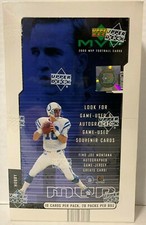
Prices update daily from live eBay listings. Prefer to buy in person? Find a local card shop · All NFL sealed
Quick facts
| Brand | Upper Deck |
| First year | 1999 |
| Release window | Autumn of the season year, with follow-up retail distribution |
| License | NFL licensed; five years, 1999 through 2003 |
| Box formats | Hobby box, retail box, blaster, fat pack |
| Guaranteed hits | None; parallel and insert driven with autographs at long odds |
| Typical sealed box range (Aug 2026) | Roughly $30 to $120 for most years |
Box formats for Upper Deck MVP
Hobby box
MVP hobby boxes are high pack-count, low card-cost configurations aimed at completing the base set within a box or two. The parallels rather than the base cards are the point: Gold Script, Silver Script and the numbered Super Script parallels sit on top of a large base checklist, which gives collectors a ladder to climb without needing a hit.
Retail box and blaster
Retail configurations were the core of the line's business and were produced heavily. They carry the same base set with different insert seeding and are the cheapest football wax of the era by a comfortable margin. They are also the most searched format in the line, because a searcher can work through retail cheaply looking for numbered parallels.
Fat pack
Fat packs and value packs appeared in the later years and are the format most likely to have been sitting in a big-box store rather than a card shop. They are collectible as period objects and have essentially no premium content.
Key years: prices and what trades
| Year | Sealed hobby box range (Aug 2026) | Key rookies and content | Notes |
|---|---|---|---|
| 1999 | $40-$110 | Ricky Williams, Edgerrin James, Donovan McNabb, Daunte Culpepper, Torry Holt | Debut year, largest print |
| 2000 | $60-$180 | Tom Brady, Brian Urlacher, Shaun Alexander, Jamal Lewis, Chad Pennington | The only year with a real premium |
| 2001 | $40-$120 | Drew Brees, LaDainian Tomlinson, Michael Vick, Reggie Wayne | Deep quarterback class |
| 2002 | $30-$90 | Julius Peppers, Ed Reed, Clinton Portis | Thin market |
| 2003 | $30-$100 | Carson Palmer, Andre Johnson, Anquan Boldin, Terrell Suggs | Final year |
The pattern is simple. 2000 carries a premium because every 2000 football product carries a Brady premium, and MVP is the cheapest way to buy a sealed box that contains him. 2001 is the sleeper on checklist quality, with Brees, Tomlinson and Vick in the same set, but the cards have never commanded much because MVP rookies are nobody's primary rookie card. The remaining years trade as inexpensive nostalgia wax.
Price data here is weak, and it is worth saying plainly. MVP was a retail-first product from before comprehensive sales tracking, sealed boxes are low value enough that many sales happen at shows and in shop cases without ever appearing online, and no mainstream price guide indexes this wax. The bands above are corridors from dealer asks and scattered results. Shipping cost is a meaningful fraction of the price on these boxes, which distorts online comparisons further.
Chase cards, parallels and hit rates
The parallel ladder is the identity of the brand. Silver Script and Gold Script parallels run through the base set at differing frequencies, with Super Script serial numbered at short print runs at the top. Because the base sets are large, completing a parallel run is a real project, which is exactly what the product was designed for.
Inserts vary by year and lean toward theme sets rather than memorabilia. Autographed content exists in some years at long odds, and the later years added limited game-jersey content, but no MVP box guarantees a hit and none should be bought expecting one. Any listing that describes an MVP football box as containing a guaranteed autograph or relic is describing something the product does not promise.
The practical consequence is that box value is driven by rookie content and by whether the numbered parallels of that year's stars are worth anything. In most years they are not.
Is Upper Deck MVP football worth buying sealed?
As a value proposition it is honest: cheap boxes, plenty of cards, a design most people remember fondly and no pretence of being high-end. If you want to open football wax from this era without spending real money, MVP is the correct answer, and 2001 in particular delivers a strong checklist for very little.
As an investment it is weak. Print runs were large, the cards are commons in every practical sense, and the only serious upside is a numbered Brady parallel in 2000, which is a narrow needle in a large haystack. The line is finished, since Upper Deck holds no NFL license and has no route back to one, but a closed print run does not create value in a product that was made in enormous quantities.
The sensible position is to treat MVP as a ripping product for enjoyment, buy it near the bottom of the range, and not confuse a fixed supply with scarcity.
How to spot fakes and resealed boxes
Low-value wax gets less counterfeiting attention but more casual searching, because the cost of buying a box to search is trivial. Retail blasters and fat packs are the worst offenders: they are opened, checked for numbered parallels and reshrunk with cheap film that is easy to spot once you know what to look for.
Original Upper Deck retail wrap from this period is thin, tight and follows the box corners, and the factory seams sit tucked under an edge. Reshrink is thicker, glossier, and usually shows a heat seam running across a flat face, sometimes with a puckered spot where the heat gun lingered. Check that the pack count matches the configuration, that packs sit at uniform height, and that no pack shows a slit or retaped seam.
Because MVP boxes are inexpensive, BBCE-style third-party authentication is rarely economic here; the authentication cost can approach the box price. That is a legitimate reason to accept a little more risk in exchange for paying less, but it also means you should buy from sellers with sealed-wax feedback and insist on photographs of every face of the box. Weighing packs is not useful, since the numbered parallels are the same stock as the base cards.
Where to buy Upper Deck MVP football sealed
MVP is classic shop-shelf inventory, often priced at whatever the store paid decades ago, so the card shop directory is the most efficient starting point. Card shows are where dealers dump this era in bulk, frequently several boxes for one negotiated price, which is the cheapest way to buy it. Online, watch shipping costs and search precisely:
Frequently asked questions
Is Upper Deck MVP football still made?
No. The football line ran from 1999 through 2003 and was retired. Upper Deck lost the NFL license after the 2009 season, so no new NFL-licensed MVP football can be produced.
What years did Upper Deck MVP football come out?
Five consecutive years: 1999, 2000, 2001, 2002 and 2003. MVP also existed in other sports with different year ranges.
How much is an Upper Deck MVP football box worth?
Most years trade in the $30 to $120 range, with 2000 the strongest at roughly $60 to $180 because of Tom Brady. Sales data is thin, so treat those as corridors.
Are there autographs in Upper Deck MVP football?
Some years include autographed content at long odds, but no MVP box guarantees a hit. Listings promising a guaranteed autograph are overstating the product.
What are Gold Script and Silver Script parallels?
They are the brand's signature parallel ladder, running through the large base set at different frequencies, with serial-numbered Super Script parallels sitting above them.
Which Upper Deck MVP football year is best?
2000 for value because of the Brady rookie content, and 2001 for checklist quality because it holds Drew Brees, LaDainian Tomlinson and Michael Vick in one set.
Prices in this guide were last reviewed 2026-08. Live eBay listings above update daily.