Upper Deck SPx Football: Sealed Box Prices, Holograms and Key Years

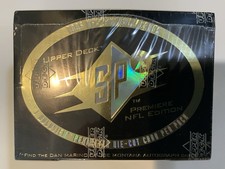

SPx was Upper Deck's technology brand, built around a die-cut hologram front that looked like nothing else on the shelf in 1996 and that still photographs badly enough to fool people into thinking a mint card is damaged. It ran almost continuously from 1996 to 2010 under an NFL license, skipped 2011, then reappeared for three collegiate years through 2014. Sealed SPx football is inexpensive relative to its reputation, with one significant exception around the 2000 rookie class.
Buy Upper Deck SPx Football sealed
All listings on eBay →Prices update daily from live eBay listings. Prefer to buy in person? Find a local card shop · All NFL sealed

Quick facts
| Brand | Upper Deck |
| First year | 1996 |
| Release window | Autumn through the following spring |
| License | NFL licensed 1996 through 2010; collegiate 2012 through 2014 |
| Box formats | Hobby box, retail box, early tins, sealed case |
| Guaranteed hits | Small packs with a hit-heavy structure; typically one to four hits per box from 2001 |
| Typical hobby box range (Aug 2026) | $60 to $250 for most years; more for 2000 |
Box formats for SPx
Hobby box (early years)
The 1996 through 1999 boxes are small-count configurations, typically packs of one to four cards, sold at a premium per pack because the die-cut hologram cards were expensive to produce. These boxes look slight next to a 36-pack wax box and are priced accordingly per card. The whole point of the early product is the technology, not the volume.
Hobby box (2000s)
From roughly 2001 SPx became a hit-driven box built around Winning Materials game-used cards and Rookie Jersey Autographs. Configurations moved around, but the shape is consistent: few cards, several hits, and a checklist where rookie autographed jersey cards carry the value. This is where most sealed SPx you will find today comes from, and it is the most reasonably priced part of the line.
Hobby box (collegiate era)
The 2012 through 2014 boxes use an NCAA license with players in college uniforms. They are cheap, they contain autographs, and they are honest fun to open, but they do not contain NFL rookie cards and should not be priced as though they do.
Retail and tins
Early SPx appeared in tins and retail configurations aimed at mall shops. These are collectible as objects but carry no hit structure worth chasing and trade well below hobby.
Cases
Sealed cases surface occasionally. As with every product in this era, a factory case is the cleanest provenance you can buy and removes the search question that dominates loose sealed boxes.
Key years: prices and what trades
| Year | Sealed hobby box range (Aug 2026) | What is inside | Why it trades |
|---|---|---|---|
| 1996 | $120-$300 | Small die-cut hologram packs | Debut year; the design that defined the brand |
| 1998 | $100-$250 | Hologram base plus inserts | Peyton Manning and Randy Moss rookie year |
| 2000 | $300-$900 | Hologram base, Rookie Jersey autos | Tom Brady rookie content; the year everyone hunts |
| 2001 | $90-$200 | Winning Materials era begins | Drew Brees, LaDainian Tomlinson, Michael Vick |
| 2005 | $70-$180 | Hit-driven box | Aaron Rodgers rookie year |
| 2013 | $60-$140 | Collegiate autographs | Le'Veon Bell, Eddie Lacy; NCAA-licensed |
The 2000 box is the one with a real premium, and for the same reason as every other product from that year: Brady. SPx rookie content from 2000 is scarce, serial numbered and, in the case of the rookie jersey autograph parallels, produced in very small quantities, so sealed boxes get bought on the chance. It is a smaller premium than 2000 SP Authentic commands because the SPx rookie structure is different, but it is real.
Everything else is a modest market. Sealed SPx football does not have a published price index; the mainstream guides cover single cards. The ranges above are drawn from dealer asks and infrequent auction results, and for several years there is essentially no public sold data at all. If you see a confident, precise price for a 2003 or 2007 SPx football box, be skeptical of where it came from.
Chase cards, parallels and hit rates
The base card is the chase in the early years. SPx cards use a die-cut window over a hologram, and because the die-cut edges chip, high-grade examples of even common players are surprisingly scarce. That is the quiet story of this brand: population reports for SPx in gem grades are thin relative to print runs.
From 2001 the chase moved to hits. Winning Materials is the signature game-used insert, often combining multiple swatches, and Rookie Jersey Autographs are the marquee rookie card of each year with serial-numbered parallels running to single digits. Spectrum and Radiance parallels appear across the 2000s at short print runs. The collegiate years use the same hit structure with college photography.
Do not expect published pack odds to be reliable for the early years. Where Upper Deck printed them they were often approximate, and boxes from 1996 to 1999 do not carry a guaranteed hit at all.
Is SPx football worth buying sealed?
For most years it is a fair-value opening product rather than an investment. Boxes are cheap, hits are frequent from 2001 onward, and the base cards look far better in hand than in scans. The years worth holding sealed are 1996, because first-year status and small production make it the box that will always be asked about, and 2000, because of the rookie class.
The obvious limitation is that the line is finished. Upper Deck has no NFL license and no realistic path to one, so the NFL-era supply is capped. That is a mild positive rather than a catalyst, and it does not rescue years with weak rookie classes.
Condition is the sleeper risk. Die-cut hologram cards from this brand grade poorly, so a box that produces a strong rookie may still produce a card that comes back a 7 or 8. That materially changes the maths on buying 2000 boxes as a Brady play.
How to spot fakes and resealed boxes
Small-pack products are easier to search and reseal than big wax boxes, which makes SPx a target. Look at pack alignment first: in a factory box every pack sits at identical height with uniform spacing, and searched-and-refilled boxes almost always have a pack that sits proud or a gap that has been packed out. Original shrink is thin and follows the box corners; replacement film is thicker, glossier and often shows a heat seam across a face.
Individual SPx packs are foil rather than cellophane in most years, so check the crimp lines along the top and bottom of each pack for irregularity, re-crimping or adhesive residue. Reheated foil seams often look wavy compared to factory crimps.
For 1996 through 2001, prefer BBCE-style third-party authentication. Authenticated sealed wax trades in a distinctly higher band than raw sealed, and the gap is the price of eliminating search risk on a product where a single pulled card can account for most of the box value. Weighing packs is unhelpful because hologram base cards, inserts and jersey cards do not separate cleanly by weight in a four-card pack.
Where to buy SPx football sealed
Local shops are the most likely source for 1996 through 2005 boxes that have never been listed online. Card shows let you inspect pack alignment and foil crimps before paying, which matters more on this product than on modern wax. Online, these searches work:
Frequently asked questions
Is SPx football still made?
No. Upper Deck's NFL license ended after the 2009 season and the last NFL-era SPx football was the 2010 release. Collegiate SPx football ran from 2012 to 2014 and the line has not returned.
What years was SPx football produced?
Continuously from 1996 through 2010, with no 2011 release, then collegiate editions in 2012, 2013 and 2014.
How much is a 1996 SPx football box worth?
Roughly $120 to $300 depending on condition and authentication. Sales are infrequent enough that the spread is wide and individual results vary a great deal.
What are SPx Winning Materials cards?
Winning Materials is the brand's game-used memorabilia insert from the 2000s, often combining multiple swatches on one card, with serial-numbered parallels down to very short print runs.
Why do SPx cards grade poorly?
The die-cut hologram fronts chip at the edges and show handling easily, so high-grade examples are scarcer than print runs suggest. That is worth factoring in before buying sealed boxes as a rookie-card play.
Are 2012-2014 SPx football cards NFL rookie cards?
No. Those years use a collegiate license with players in college uniforms, so they are treated as collegiate issues rather than NFL rookie cards.
Related sets
Prices in this guide were last reviewed 2026-08. Live eBay listings above update daily.