Upper Deck SP Football: Sealed Box Prices, Key Years and Die-Cut Chases
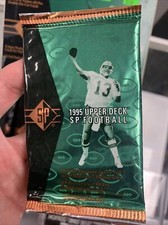

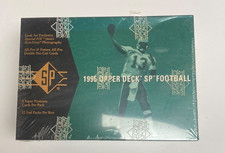

SP was Upper Deck's first premium football brand, launched in 1993 with foil-fronted, full-bleed cards on stock nobody else was using and a Premier Prospects subset that gave the set its identity. It ran four consecutive years, disappeared after 1996 when SP Authentic took over the premium slot, and returned once as a standalone 2009 release before Upper Deck lost the NFL license. Sealed SP football is a small, quiet market where the die-cut chases drive everything and provenance matters more than the year on the box.
Buy Upper Deck SP Football sealed
All listings on eBay →Prices update daily from live eBay listings. Prefer to buy in person? Find a local card shop · All NFL sealed

Quick facts
| Brand | Upper Deck |
| First year | 1993 |
| Release window | Late summer through autumn in the 1990s |
| License | NFL licensed; 1993, 1994, 1995, 1996 and a one-off 2009 return |
| Box formats | Hobby wax box, retail box, sealed case |
| Guaranteed hits | None in the classic run; die-cut parallels seeded per pack in 1994 |
| Typical hobby box range (Aug 2026) | $80 to $300 depending on year and authentication |
Box formats for Upper Deck SP
1993 hobby box
The debut box is 24 packs of 12 cards. It is the largest configuration in the line and the cheapest way into the set, which is built around the Premier Prospects subset at cards 1-18 and the All-Pro die-cut insert falling roughly one in fifteen packs. Boxes turn up regularly but rarely in quantity, and dealer asks sit across a wide band because two boxes from different sellers can carry very different search histories.
1994 hobby box
The 1994 configuration is 30 packs of eight cards and is the most collector-friendly of the run, because the SP Die-Cut parallel falls at roughly one per pack. That means a box yields a full stack of die-cuts rather than a single lottery ticket, and it makes 1994 the box most people actually open. Retail asks around $130 have been common at established dealers, with the wider market spread running roughly $100 to $200.
1995 and 1996 hobby boxes
These years shrank in profile as SP Authentic came into view. Both carry Holoview-style hologram inserts and die-cut parallels, and both trade thinly. Sealed boxes appear a handful of times a year, so a single motivated buyer can move the apparent price sharply.
2009 SP hobby box
The 2009 revival is a different animal: a modern hit-driven configuration with autographs and memorabilia rather than a set-building wax box. It was Upper Deck's last SP-branded NFL football product and is inexpensive relative to the 1990s boxes.
Sealed cases
Cases surface occasionally for 1993 and 1994. A factory-sealed case is the strongest provenance available in this line and typically brings a meaningful premium per box over loose sealed boxes, because it removes the search question entirely.
Key years: prices and what trades
| Year | Sealed hobby box range (Aug 2026) | Configuration | Why it trades |
|---|---|---|---|
| 1993 | $150-$350 | 24 x 12 | Drew Bledsoe #9, Jerome Bettis, Mark Brunell, Willie Roaf, John Lynch; All-Pro die-cuts |
| 1994 | $100-$200 | 30 x 8 | Marshall Faulk, Trent Dilfer; SP Die-Cut roughly 1:1 |
| 1995 | $90-$200 | 32 x 8 | Steve McNair, Kerry Collins, Curtis Martin; Holoview inserts |
| 1996 | $80-$180 | 24 x 8 | Eddie George, Terrell Owens, Marvin Harrison; final classic year |
| 2009 | $60-$150 | Modern hit box | Matthew Stafford, Mark Sanchez, Percy Harvin; last SP NFL release |
The 1993 box is the one that carries the brand. It is the first year, it holds the Bledsoe Premier Prospect and a Hall of Fame rookie class in Bettis, Roaf and Lynch, and the All-Pro die-cut is a genuinely scarce insert by 1993 standards. 1994 is the collector's box rather than the investor's box, because a die-cut per pack makes it fun to open and caps the surprise. The 1996 box quietly holds one of the better rookie classes of the decade in Owens and Harrison, and it is underpriced relative to that class, though nobody should expect a set of commons to fund a retirement.
Sold data here is genuinely thin. There is no continuous sealed-box price index for 1990s SP football; the major guides track single cards. The ranges above come from dealer asking prices and scattered auction results, and a year can go months without a public sale. Treat any single number you see as one observation.
Chase cards, parallels and hit rates
The signature of the brand is the die-cut. In 1993 the All-Pro insert used a die-cut gold-foil top and fell about one in fifteen packs. In 1994 Upper Deck flipped the model and made the die-cut parallel a near-per-pack pull, with Die-Cut All-Pro cards at much longer odds around one in seventy-five packs. The 1995 and 1996 sets carried Holoview and hologram-based inserts that were technically ambitious for the time and that now grade poorly, which is why high-grade examples carry outsized premiums.
There are no autographs in the classic run. Anyone advertising a guaranteed autograph in a 1993 to 1996 SP football box is describing a product that does not exist. The 2009 release is the only SP football year with seeded autographs and memorabilia.
Is Upper Deck SP football worth buying sealed?
As an opening proposition, the honest answer for 1994 through 1996 is that the expected value of a box sits below its price; the base cards are commons and the die-cuts of non-stars are worth a few dollars. The case for holding sealed is stronger for 1993, where the combination of first-year status, a strong rookie class and genuinely low surviving box counts gives the box a scarcity story that junk-wax flagship products do not have.
The line is closed. Upper Deck has no NFL license and no route back to one, so the supply of NFL-licensed SP football wax is fixed at what already exists. That supports the whole run gently over time, but it is a slow story and not a catalyst.
How to spot fakes and resealed boxes
The main risk in 1990s SP is a searched-and-reshrunk box rather than a counterfeit. Original wrap is thin and follows the box corners tightly; replacement shrink is thicker, shinier and often has a heat seam across a flat face instead of tucked under an edge. Check that every pack sits at the same height, look for cellophane that has been slit and retaped at the pack seam, and be suspicious of a box whose flap glue has clearly been lifted and re-set.
Because 1994 die-cuts fall so frequently, searchers can pull value without leaving obvious gaps, which makes 1994 a favourite target. For 1993 in particular, prefer BBCE-style third-party authenticated boxes; an authenticated, unsearched-graded box regularly brings a substantial premium over a raw sealed one, and that premium is exactly the cost of certainty. Authenticated wax and raw sealed wax trade as two separate markets, so compare like with like when you are reading completed listings. Weighing packs is not useful here since die-cuts and base cards are close enough in weight to be indistinguishable in practice.
Where to buy Upper Deck SP football sealed
This is dealer inventory rather than online inventory. Shops that have been open since the 1990s often still hold SP boxes at prices set years ago. Card shows are the best place to physically inspect a box before buying, which matters more here than in any modern product. Online, use tight searches:
Frequently asked questions
Is Upper Deck SP football still made?
No. The classic run ended after 1996, a single revival year appeared in 2009, and Upper Deck lost the NFL license after the 2009 season. No new NFL-licensed SP football will be produced.
What years did SP football come out?
1993, 1994, 1995 and 1996 as a continuous run, plus a one-off 2009 release. SP Authentic replaced it as Upper Deck's premium football brand from 1997.
How much is a 1993 SP football box worth?
Roughly $150 to $350 unauthenticated, with authenticated boxes above that. Public sales are infrequent, so the spread is wide and any one price is a weak signal.
What is the SP die-cut parallel?
It is the brand's signature chase. In 1993 the All-Pro insert used a die-cut top at about one in fifteen packs; in 1994 the die-cut parallel fell close to one per pack, with a much scarcer Die-Cut All-Pro version at roughly one in seventy-five.
Are there autographs in SP football boxes?
Not in the 1993-1996 run. Only the 2009 release includes seeded autographs and memorabilia cards.
Should I buy authenticated SP football wax?
For 1993 especially, yes. Searched-and-resealed boxes are common in this era, and a BBCE-style authenticated box removes that question at a premium that most buyers find worth paying.
Related sets
Prices in this guide were last reviewed 2026-08. Live eBay listings above update daily.