Upper Deck Football: Sealed Box Prices, Key Years and Rookie Cards
Upper Deck entered football in 1991 with a 700-card flagship set, a Brett Favre rookie card and photography that made every competitor look dated overnight. The line ran under an NFL license through the 2009 season, disappeared after Upper Deck failed to renew in April 2010, and returned in 2011 as a collegiate product with players shown in college uniforms. Sealed Upper Deck football wax is now a vintage market with thin sold data, wide spreads and a real resealing problem, so this page covers what actually trades and how to buy it safely.
Buy Upper Deck Football sealed
All listings on eBay → 1991 Wax Pack
$3.33
1991 Wax Pack
$3.33
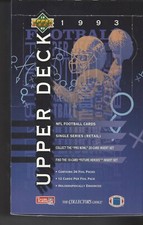 1993 Wax Pack
$6.95
1993 Wax Pack
$6.95
 1992 Wax Pack
$7.50
1992 Wax Pack
$7.50
 1991 Wax Box
$25.00
1991 Wax Box
$25.00
 1993 Wax Box
$44.99
1993 Wax Box
$44.99
 1997 Hobby Box
$80.00
1997 Hobby Box
$80.00
Prices update daily from live eBay listings. Prefer to buy in person? Find a local card shop · All NFL sealed
Quick facts
| Brand | Upper Deck |
| First year | 1991 |
| Release window | Historically summer (low series) with a late-season high series through the 1990s |
| License | NFL licensed 1991 through the 2009 season; NCAA/CLC collegiate from 2011 |
| Box formats | Hobby wax box, retail box, low and high series, jumbo packs, blasters, factory sets |
| Guaranteed hits | None in the 1990s; game-jersey and autograph inserts seeded from 1997 onward |
| Typical hobby box range (Aug 2026) | $30 to $150 for most 1990s years; far higher for 2000 |
Box formats for Upper Deck Football
Hobby wax box (1990s)
The early flagship boxes are 36 packs of 12 cards, and 1991 was split into a Low Series (cards 1-600) and a High Series (601-700). Low series boxes are the ones collectors want because the Favre Star Rookie at #13 lives there; high series boxes carry the #647 Rookie Force Favre and trade for a fraction of the price. Expect roughly $35 to $90 for a clean unauthenticated 1991 low series box and $10 to $30 for high series, with authenticated examples above that.
Hobby box (2000s)
From the late 1990s the configuration tightened to 24 packs of five to eight cards with seeded Game Jersey, Game Jersey Autograph and Star Rookies inserts. These boxes are heavier on hits and lighter on volume, and the 2000 through 2005 range is where the flagship stopped being a set-building product and started being a hit product.
Retail, jumbo and blaster
Retail boxes, jumbo packs and later blasters exist for most years and sell for well under hobby. They are the most frequently searched and resealed configuration in the entire brand, and they carry no meaningful premium, so there is rarely a reason to pay up for sealed retail unless you are opening it.
Factory sets
Upper Deck issued factory sets in most 1990s years. A sealed factory set is a cheap way to own a complete run including the Favre rookie, but it has no wax upside and should not be confused with a sealed box in a listing title.
Cases
Sealed 1990s cases surface occasionally, usually 12 or 20 boxes. Case-fresh boxes carry a premium with collectors who care about search risk, and an intact factory case is the single strongest provenance you can buy in this era.
Key years: prices and what trades
| Year | Sealed box range (Aug 2026) | Format | Why it trades |
|---|---|---|---|
| 1991 (Low) | $35-$90 | 36 x 12 wax | Brett Favre Star Rookie #13; Football Heroes Montana |
| 1994 | $40-$110 | 36 x 12 | Marshall Faulk, Trent Dilfer; Electric Football parallels |
| 1998 | $60-$180 | 24 x 8 | Peyton Manning and Randy Moss rookie year |
| 2000 | $500-$1,800 | 24 x 8 | Tom Brady rookie #254; the only genuinely scarce year |
| 2001 | $90-$250 | 24 x 8 | Drew Brees, LaDainian Tomlinson, Michael Vick |
| 2005 | $70-$200 | 24 x 8 | Aaron Rodgers rookie year |
Two of these behave differently from the rest. 2000 is the only Upper Deck flagship year with a genuine scarcity story, because the Brady rookie sits in a print run that was consumed long before anyone knew who he was, and sealed boxes are now bought as lottery tickets rather than as product. Everything else in the 1991 to 1998 window is junk-wax-era printing, produced in quantities that no amount of demand will exhaust, and prices there reflect nostalgia and the cost of finding an unsearched box rather than any real scarcity.
Be honest with yourself about the data. There is no continuous, reliable sold-price feed for most Upper Deck football wax; the mainstream price trackers cover single cards, not these boxes. The ranges above are drawn from dealer asks and scattered auction results and should be treated as a corridor, not a quote. For thinly traded years such as 1993, 1996 and 2007, you may see two sales a year and a 100 percent spread between them.
Chase cards, parallels and hit rates
The 1991 set is remembered for the Favre rookie, the Joe Montana Football Heroes insert with a 2,500-copy signed card, the Game Breakers holograms and the Don Shula 300th win short print. Through the mid-1990s the chase was parallels: Electric Football, SP inserts and the die-cut subsets. From 1997 Upper Deck seeded Game Jersey cards, and from 2000 Game Jersey Autographs and Game Jersey Patches at very long odds. The 2000 set's Star Rookies fall about one in four packs, which is why so many Brady rookies survive in raw condition and so few survive in gem grade.
Do not expect a hit per box from anything before 1997. These are set-building boxes with insert chases, and the value of a sealed box is the possibility of a high-grade rookie, not a numbered autograph.
Is Upper Deck football worth buying sealed?
For most years, no, if you are buying to open. Junk-wax-era Upper Deck was printed heavily, the base cards are worth cents and the realistic outcome is a stack of commons and a Favre in an unremarkable grade. The case for sealed is narrower and more specific: 2000 for the Brady, 1991 low series as a cheap and recognizable piece of wax that people will always want, and sealed cases as a provenance play. The collegiate 2011 through 2015 years are inexpensive and interesting but are not NFL rookie cards, which caps their ceiling.
The line is finished either way. Upper Deck has no NFL license and no path back to one while Fanatics holds the category, so nothing new will be added to the supply of NFL-licensed Upper Deck football.
How to spot fakes and resealed boxes
Resealing is the central risk in this era. Original Upper Deck wax boxes were shrink-wrapped in thin, tight film that follows the box corners closely; modern reshrink is thicker, glossier and often shows a seam running across a face rather than tucked under. Look for cut-and-retaped cellophane on individual packs, packs that sit unevenly in the box, and boxes where the flap glue has clearly been lifted. A box that has been searched for the Favre or Brady rookie and refilled with commons looks perfect from three feet away.
For anything pre-2000, buy authenticated where you can. BBCE-style third-party authentication grades the box as unsearched and wraps it, and an authenticated box routinely brings a 30 to 60 percent premium over a raw sealed one because that premium is the price of removing the search question. Raw sealed and authenticated sealed are effectively two different markets, and listings that blur them should be avoided. Weighing packs tells you almost nothing here, since inserts weigh the same as base cards.
Where to buy Upper Deck football sealed
Vintage wax moves through people, not algorithms. Local shops sit on 1990s inventory they bought decades ago and will often price it below the online market, so start with the card shop directory. Card shows are the best venue in this category because you can handle the box, check the wrap and negotiate. Online, these searches keep results clean:
Frequently asked questions
Is Upper Deck football still made?
No NFL version is. Upper Deck's NFL license ended after the 2009 season and the company confirmed in April 2010 that it had not reached new terms with the league. Upper Deck returned to football in 2011 under a collegiate license with players in college uniforms and ended that run after 2015.
How much is a 1991 Upper Deck football box worth?
Low series boxes generally trade in the $35 to $90 range unauthenticated, with high series boxes much cheaper at roughly $10 to $30. Authenticated boxes bring more. Sold data is sparse, so treat any single price as one data point.
Which Upper Deck football year is the most valuable sealed?
2000, by a wide margin, because of the Tom Brady rookie at card #254. Sealed 2000 hobby boxes trade in the high hundreds to low thousands depending on condition and provenance.
Does Upper Deck football wax get resealed?
Frequently. Boxes are searched for Favre and Brady rookies and reshrunk. Check the wrap tightness, look for retaped packs, and prefer third-party authenticated boxes for anything from the 1990s.
Are the 2011-2015 Upper Deck football cards rookie cards?
They show players in college uniforms under a collegiate license, not an NFL one. Collectors treat them as pre-rookie or collegiate issues rather than true NFL rookie cards, and they price accordingly.
Is there reliable price data for Upper Deck football sealed boxes?
Not really. The major price guides track single cards, not this wax. Ranges come from dealer asks and scattered auction results, and spreads of 50 to 100 percent within a year are normal.
Prices in this guide were last reviewed 2026-08. Live eBay listings above update daily.